

Sorry, your browser does not support videos.
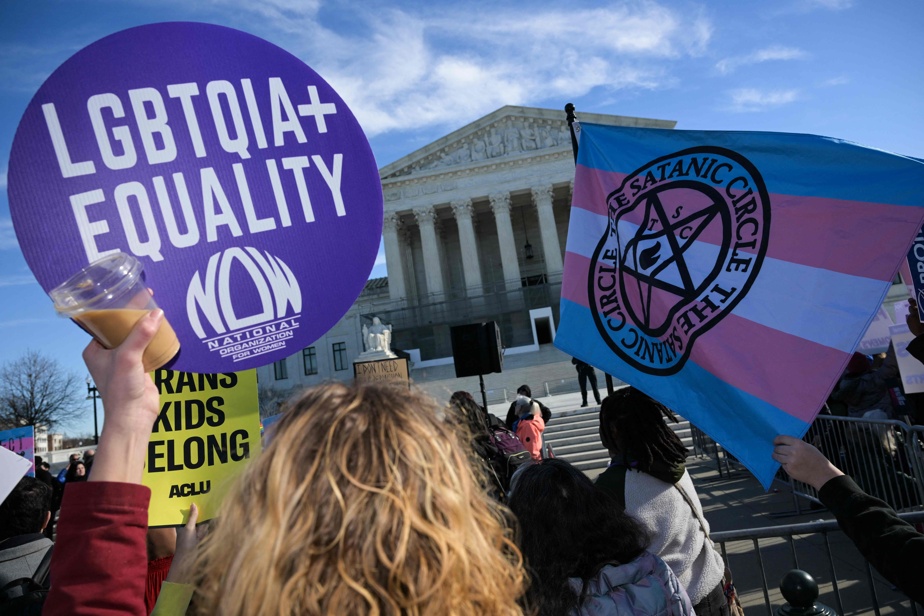
(Washington) The predominantly conservative American Supreme Court discusses on Tuesday an issue that has become explosive: the right of transgender girls or women to participate in school and university women’s sports competitions.
Published at
Donald Trump has made the rights of transgender people one of the axes of his campaign in 2024, promising to put an end to the “transgender delirium”. As of January 20, 2025, the day of his inauguration, the Republican president signed a decree according to which his administration would henceforth recognize the existence of only “two sexes, male and female”, defined at birth.
He also signed an executive order in February authorizing federal agencies to cut funding to schools that allow transgender athletes to compete in women’s championships.
At issue Tuesday before the nine judges of the Supreme Court: the laws adopted by the conservative states of Idaho and West Virginia which, like more than half of American states, prohibit transgender women from participating in women’s competitions.
In Idaho, a pioneer of this type of legislation in the United States, a transgender student at Boise State University, Lindsay Hecox, challenged its exclusion from sporting events.
A federal appeals court ruled in his favor, finding that the law violated a provision of the Fourteenth Amendment to the US Constitution on “equal protection” of citizens.
In West Virginia, it concerns a transgender minor who another federal appeals court concluded was subject to discrimination based on sex, prohibited by American law.
“Countless advantages”
Supported by the Trump administration, the two states say they simply want to uphold sports fairness and safety. They say the participation of transgender athletes in women’s events would increase the risk of injury for girls and women facing opponents who are expected to be more physically powerful.
“Idaho law establishes classifications on the basis of sex because sex is what matters in sports,” State Representative Alan Hurst said Tuesday at the opening of the debates.
He spoke of the “countless athletic advantages such as greater height, muscle and bone mass, heart and lung capacity” that he believes transgender athletes benefit from compared to their opponents.
“Denying a special arrangement to people who identify as transsexuals does not constitute discrimination on the basis of sex and does not deny them equal protection under the law,” also argued the representative of the Department of Justice of the Trump administration, Hashim Mooppan.
But concerned transgender athletes are urging the Supreme Court to declare these laws illegal and discriminatory.
“Government discrimination against transgender people will only intensify if this court rules that laws discriminating against transgender Americans are presumptively constitutional,” Lindsay Hecox’s lawyers warn in their written arguments.
The decision of the nine judges is expected by the end of the annual session of the Supreme Court at the end of June.
In June, the Court allowed Tennessee to prohibit transgender minors from accessing transition treatment, considering that the law adopted in this matter by this state was not discriminatory in nature.



