


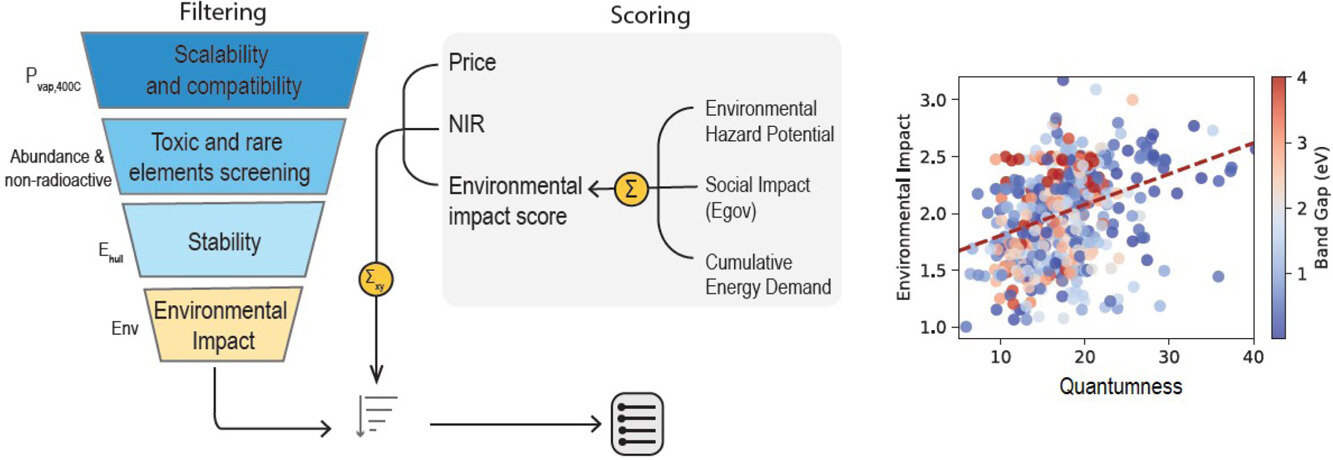
Credit: Materials today (2025). DOI: 10.1016/j.mattod.2025.09.014
People tend to view quantum materials, whose properties arise from the effects of quantum mechanics, as exotic curiosities. But some quantum materials have become ubiquitous in our computer hard drives, television screens and medical devices. However, the vast majority of quantum materials never contribute much outside the laboratory.
What makes some quantum materials commercially successful and others commercially irrelevant? If researchers knew this, they could focus their efforts on more promising materials – which would be a big problem since they could spend years studying a single material.
Now, MIT researchers have developed a system to assess the scaling potential of quantum materials. Their framework combines the quantum behavior of a material with its cost, supply chain resilience, environmental footprint, and other factors.
The researchers used their framework to evaluate more than 16,000 materials, finding that materials with the strongest quantum fluctuation at the center of their electrons also tend to be more expensive and more environmentally damaging. The researchers also identified a set of materials that achieve a balance between quantum functionality and durability for further study.
The team hopes their approach will help guide the development of more commercially viable quantum materials that could be used for next-generation microelectronics, energy harvesting applications, medical diagnostics, and more. Their study is published in the journal Materials today.
“People who study quantum materials are very focused on their properties and quantum mechanics,” says Mingda Li, associate professor of nuclear science and engineering and lead author of the work. “For some reason, they have a natural resistance to the idea, when doing basic materials research, of thinking about costs and other factors. Some have told me they think these factors are too ‘trivial’ or irrelevant to the science. But I think that within 10 years, people will systematically think about costs and environmental impact at every stage of development.”
Impact materials
Co-authors Mouyang Cheng and Artittaya Boonkird say materials science researchers often look to quantum materials with the most exotic quantum properties rather than those most likely to be used in world-changing products.
“Researchers don’t always think about the costs or environmental impacts of the materials they study,” says Cheng. “But these factors may make it impossible to take action with them.”
Li and his collaborators wanted to help researchers focus on quantum materials with more potential for industrial adoption. For this study, they developed methods for evaluating factors such as material price and environmental impact using their items and common practices for extracting and processing those items. At the same time, they quantified the “quantity” level of the materials using an AI model created by the same group last year, based on a concept proposed by MIT physics professor Liang Fu called quantum weight.
“For a long time, we didn’t know how to quantify the quantum character of a material,” Fu explains. “Quantum weight is very useful for this purpose. Basically, the higher the quantum weight of a material, the more quantum it is.”
The researchers focused on a class of quantum materials with exotic electronic properties, called topological materials, and ultimately assigned more than 16,000 material scores in terms of environmental impact, price, import resilience, and more.
For the first time, researchers discovered a strong correlation between the quantum weight of the material and its cost and environmental impact.
“This is useful information because industry really wants something very inexpensive,” says Ellan Spero, an instructor in the Department of Materials Science and Engineering. “We know what we should be looking for: materials with high quantum weight and low cost. Very few materials developed meet these criteria, which is probably why they are not suitable for industry.”
The researchers identified 200 ecologically sustainable materials and refined the list down to 31 candidate materials that achieved an optimal balance between quantum functionality and high-potential impact.
The researchers also found that several widely studied materials have high environmental impact scores, indicating they will be difficult to scale sustainably. “Considering manufacturing scalability as well as availability and environmental impact is essential to ensure the practical adoption of these materials in emerging technologies,” says Associate Professor Farnaz Niroui of the Department of Electrical Engineering and Computer Science (EECS).
Direct the research
Many of the topological materials evaluated in the paper have never been synthesized, which limited the accuracy of the study’s environmental and financial predictions. But the authors say researchers are already working with companies to study some of the promising materials identified in the paper.
“We’ve talked to people working at semiconductor companies who have told us that some of these materials are really interesting to them, and our chemist collaborators have also identified some materials that they find really interesting from this work,” says Professor Tomas Palacios from EECS. “We now want to study these cheaper topological materials experimentally to better understand their performance.”
“Solar cells have an efficiency limit of 34%, but many topological materials have a theoretical limit of 89%. Plus, you can harvest energy across all electromagnetic bands, including our body heat,” says Fu. “If we could reach these limits, you could easily charge your cell phone using body heat. These are performances that have been demonstrated in the laboratory, but which can never be scaled up. This is the kind of thing we are trying to advance.”
More information:
Artittaya Boonkird et al, Are quantum materials economically and ecologically sustainable? Materials today (2025). DOI: 10.1016/j.mattod.2025.09.014
Provided by the Massachusetts Institute of Technology
This story is republished courtesy of MIT News (web.mit.edu/newsoffice/), a popular site that covers news in MIT research, innovation and education.
Quote: Why some quantum materials stagnate while others evolve (2025, October 15) retrieved October 15, 2025 from
This document is subject to copyright. Except for fair use for private study or research purposes, no part may be reproduced without written permission. The content is provided for informational purposes only.


