

(WASHINGTON) President Donald Trump was in complaining mode, reminding reporters of New York Times who he felt had not been treated with respect by the media, the Norwegian Nobel Prize Committee, the mayor of New York, Democratic officials and several Republicans.
Published at
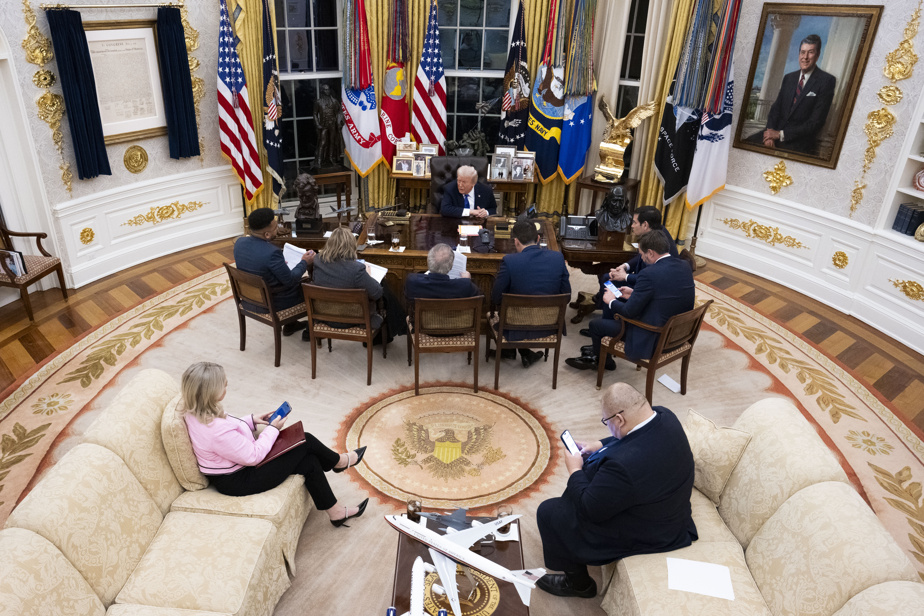
During Wednesday’s lengthy interview with the newspaper, he played the role of gracious host, pressing a button to summon a valet who brought water and Diet Coke, and showing off several centuries-old American portraits with a laser pointer while detailing for his visitors his Oval Office renovations.
He spoke in a fatherly tone about his assistants and advisors in the room, calling them “the kids”, including Vice President JD Vance, 41, and Secretary of State Marco Rubio, 54. Both were wearing shoes he had given them.
PHOTO DOUG MILLS, NEW YORK TIMES
President Donald Trump insisted on showing journalists who came to interview him around the White House.
He put on his construction helmet, slipping back into the character of the real estate developer from Queens, now determined to transform the White House into a high-end residence of which he will be proud. Mr. Trump recalled that part of his life — when newspapers spoke highly of him — between questions about the chaos in the country, for which he was largely responsible.
“I was really good at real estate,” Mr. Trump said. “Maybe better at real estate than politics,” he added.
On Wednesday evening, Trump mainly sought to present himself as tireless, displaying endurance and energy for the Timeswhom he recently accused of sedition for having discussed his health and age in its pages. (He will be 80 in June.)
PHOTO DOUG MILLS, NEW YORK TIMES
During the interview, Donald Trump repeatedly spoke about former President Joe Biden to illustrate the contrast between his predecessor and the image of vigor that he wanted to project.
During a nearly two-hour interview, followed by a tour of the White House, Trump took on the multiple personalities he showed during his decades of public life, as well as those revealed since his return to power. The result: an encounter with unpredictable turns throughout the evening. This is also his tactic as president, particularly on the international scene. If no one knows what you could do, people will often do what you want them to do.
Toward the end of the interview, when asked about the possibility of elections in Venezuela, Mr. Trump paused. An assistant had just entered with a model of her plan for a ballroom at the White House.
“Let me show you this before we talk about democracy,” he said, turning his gaze to the miniature replica of the White House complex, with its small American flags and miniature presidential helicopter.
PHOTO DOUG MILLS, NEW YORK TIMES
Donald Trump showed a document provided by TikTok which details his popularity on this platform.
At the start of the interview, Mr. Trump adopted the role he has played in public since he captured the Venezuelan president, that of the head of state supported by the most powerful army in the world.
As he moved from one role to another, it was clear that he wanted to show all of this and all facets of his personality.
The world leader
During the first scene, four minutes after we arrived, Mr. Trump was behind the Resolute desk. In front of him was Mr. Rubio, very close to a bust of Benjamin Franklin.
Suddenly, on the garden side, appeared Natalie Harp, an assistant whom the president nicknamed “AI” (as in artificial intelligence) because she carries out research on the internet and provides him with documents at his request. She helped him distribute some graphics from a document called Trump on TikTok – accompanied by a personal note from Shou Chew, the company’s CEO – which details the president’s popularity on the platform.
The president had barely begun to highlight his popularity on TikTok and lament traditional media coverage, when another aide popped up with the following note: “You have a call from Colombian President Gustavo Petro. »
PHOTO DOUG MILLS, NEW YORK TIMES
Donald Trump showed the note that an aide had just given him. As luck would have it, the president of a country called him during the interview with the New York Times.
The president put his index finger to his lips, signaling everyone present to be quiet, while sitting next to Marco Rubio. He requested and obtained that the contents of the call not be published. Subsequently, he returned to the duration of this call with Mr. Petro, which had lasted almost an hour.
“Do you think Biden could have done this? »
Full tank
This last question, in truth, could have been the title of this entire production. The name of the former president came up several times during the evening.
“Two hours!” ” Mr. Trump said of the interview as it drew to a close. “I could go on for nine hours. »
PHOTO DOUG MILLS, NEW YORK TIMES
President Donald Trump displayed his energy during the interview which lasted almost two hours.
During the interview, his age was mentioned. He was eight years older than during his first term: have certain things become more difficult, he was asked.
“I find it easier,” Mr. Trump replied. “Physically, I feel like I did before; like 40 years ago. »
He said he recently played golf with Gary Player, a 90-year-old retired professional. He praised the revered golfer and other quick-witted nonagenarians he knew.
Then, like a boomerang, Trump returned to his 83-year-old predecessor: “I think Joe Biden is the worst thing that ever happened to old people.”
He responded calmly to questions about his health, not repeating his angry outbursts about media coverage focused on his age, which he called in December “seditious, even treacherous.”
“I purposely took more medical exams than anyone else,” he said. “I just think it’s important because I think presidents should ideally be healthy and have good cognitive abilities. »
The resentful
Trump has long harbored a deep sense of injustice, feeling that he was not treated as he deserved by people who he believed should respect him.
His quest for recognition shaped every aspect of his presidency and was evident throughout the interview.
The whole world already knows about the offenses Mr. Trump mentioned during the interview, including his long-standing frustration at not having received the Nobel Peace Prize.
PHOTOS DOUG MILLS, NEW YORK TIMES
Donald Trump responded calmly to questions about his health, not repeating his angry outbursts about media coverage focused on his age, which he called in December “seditious, even treacherous.”
“I ended eight wars and I did not receive the Nobel Peace Prize. It’s pretty incredible. Obama received it. He had been there for a few weeks. He didn’t even know why he received it. »
But his desire to be adored – and his anger at not being adored enough – manifested itself in less expected ways, notably when he was asked about the conflicts of interest of his family business.
Mr. Trump said he is not worried about it because he believes he was not praised enough during his first term for preventing his sons from entering into international trade deals and for donating his presidential salary.
“I received no credit during my first term. I only received criticism. »
At this point in the interview, night had fallen on Washington. From the Oval Office, workers could be seen working under spotlights, moving the earth with machines, where the White House ballroom will be built in place of the now demolished East Wing.
Mr. Trump has insisted on presenting his $400 million ballroom project, which he says is financed with his own funds and donations.
PHOTO DOUG MILLS, NEW YORK TIMES
Towards the end of the interview, Donald Trump made a point of showing a model of his ballroom project.
The building, he said, will have bulletproof windows 4 to 5 inches thick and will be large enough to accommodate future presidential inaugurations.
“I modernize everything. I am a modernizer,” he said. “I’m a real real estate guy. »
He looked at the little world he was rebuilding.
“And this building being built right across the street, this beautiful building,” Trump said of his ballroom. “They will thank me. »
This article was published in the New York Times.
Read this article in its original version (in English; subscription required).



