

Careless error? Communication problem? Hypotheses about the cause of the fatal accident involving a plane leaving from Montreal at LaGuardia airport are gradually emerging.
Published at
What happened in the minutes before the accident?
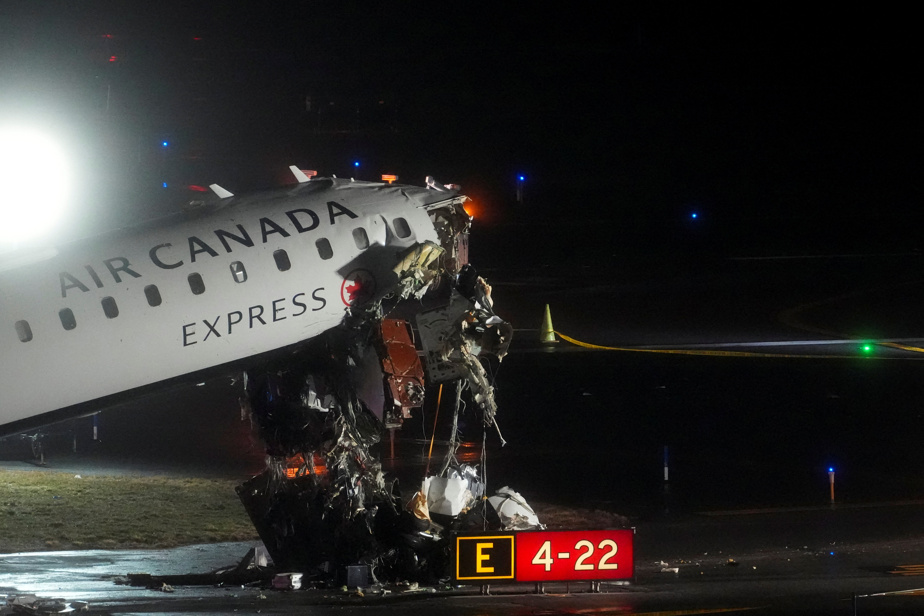
On Sunday, around 11:40 p.m., a Jazz Aviation plane, operating under the name Air Canada Express, collided head-on with a fire truck while landing at New York’s LaGuardia Airport.
Shortly before, the control tower had authorized emergency services to head towards another plane whose crew had reported a suspicious odor. The barracks are located at the west end of the airport while the aircraft to be inspected was to the east, on runway 13.
To get there, the fire vehicle had to cross runway number 4, where the Jazz Aviation plane had just been authorized to land. The collision caused the death of both pilots and injured around forty passengers.
A pilot for almost 30 years, Marc-Antoine Plourde estimates that the plane must have been traveling at more than 200 km/h at the time of impact. “He had just landed. He had slowed down a little, but he was still going very fast,” he maintains.
PHOTO SHANNON STAPLETON, REUTERS
The Jazz Aviation aircraft collided head-on with a fire truck on the landing strip.
Why did the control tower allow the Jazz Aviation plane to land?
That’s the big question. Seconds before the collision, the control tower ordered the fire truck to stop, according to recordings of the exchange made public Monday.
“The air traffic controller realized what was happening and tried to contact the fire truck, without success. We don’t even hear a “what?” or a “roger that” », remarks Marc-Antoine Plourde.
Did the firefighters receive the message? Was the communication system faulty? It is possible, says Mr. Plourde, just as it is possible that the air traffic controller simply made a careless error.
One thing is certain, the vehicle and the plane should never have been authorized to use the same runway, emphasizes the pilot, who himself landed several times at LaGuardia, an airport very busy during peak hours.
“The goal is not to find a culprit, but to understand why it happened and how we can change protocols so that it no longer happens. »
PHOTO BING GUAN, REUTERS
Many emergency vehicles at the collision site
Is the shortage of air traffic controllers to blame?
It is true that the aviation industry is experiencing a significant shortage of air traffic controllers. In the United States, thousands of positions are to be filled.
According to Marc-André Plourde, it is likely that a single controller was managing traffic on the ground and in the air at the time of the collision. That said, the practice is common during the night.
“Like most airports, there are fewer staff in the control tower because there is less traffic,” he explains. I’ve been flying planes for over 30 years and I’m used to it. »
However, is it possible that the controller involved in the collision worked multiple shifts? This is a possibility that the investigation will have to explore, says Mr. Plourde.
At Polytechnique Montréal, professor and specialist in aircraft systems safety, Philippe Doyon-Poulin, recalls that this tragedy occurs in a very specific context.
“Airports in the United States face several challenges because of investments in infrastructure which are chronically insufficient,” he says.
In the last year, numerous incidents show that the system has reached its limit, according to him. “Last year in Newark, New Jersey, for example, there were three blackouts airport for 90 seconds,” insists the specialist.
Is it safe to fly?
Do you have a flight planned in the next few days and are worried about boarding a plane? Have no fear, reassures Marc-Antoine Plourde. Plane crashes are spectacular and attention-grabbing, but they are exceptional.
“If you look at the number of travelers every year and the number of deaths, the percentage is so tiny and it decreases from year to year,” he said.
He said the accident was likely the result of human error. “The system is very, very rigid in terms of regulations,” concludes Mr. Plourde.
With Henri Ouellette-Vézina, The Press



