

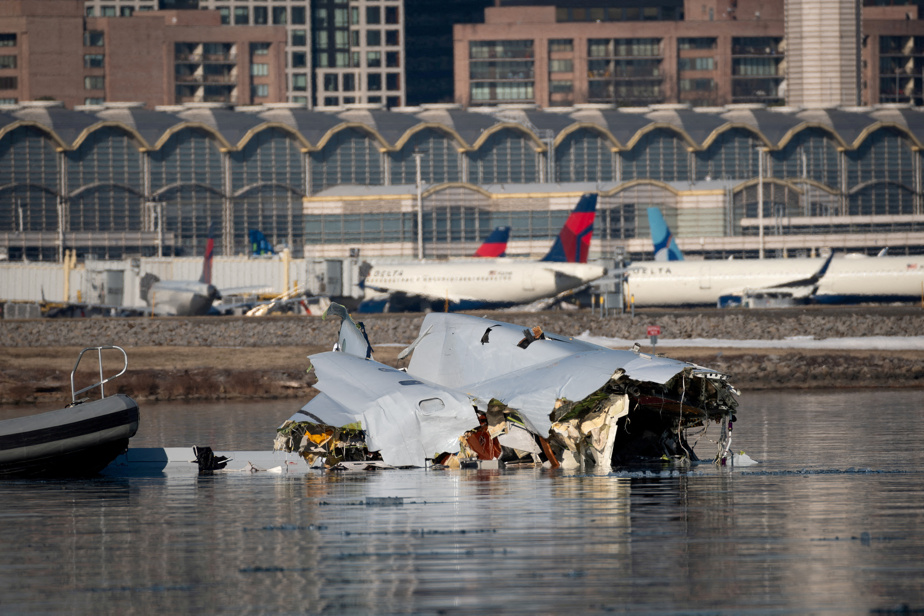
(New York) The fatal collision between an airliner and a US army helicopter which left 67 dead at the end of January 2025 near a Washington airport was “100% avoidable” said Tuesday the president of the US Transportation Safety Agency (NTSB), Jennifer Homendy.
Published at
Updated to
“We have reason to be angry,” the official said at the end of a marathon public hearing during which the NTSB studied the conclusions of its investigators on the accident of January 29, 2025 near Ronald Reagan Airport.
“We had published recommendations” before this event “which would have been applicable in this case,” she insisted. “It’s a shame. »
She attacked the civil aviation regulator, the FAA, accused of having authorized a flight corridor for helicopters that was too close to that of planes approaching one of the runways at Reagan airport.
PHOTO JACQUELYN MARTIN, ASSOCIATED PRESS ARCHIVES
NTSB Chairman Jennifer Homendy
Jennifer Homendy also criticized the FAA for being too tolerant of visual navigation by helicopters.
According to her, air traffic controllers too often leave it to pilots to visually ensure that another aircraft is not in their path, a method called “see and avoid”.
“We (the NTSB) have been talking about “see and avoid” for more than five decades,” she insisted. In nearly 50% of mid-air collisions examined by the NTSB over the past twenty years, “we reported problems related” to this method.
The investigators drew up a list of more than 70 elements on points that could be improved, relating to the personnel in the tower at the time of the accident, the content of the discussions between the two aircraft and the control tower, the regulations of the air dispatcher, etc.
“Due to poor radio reception, the crew of (the helicopter) PAT25 did not receive crucial information concerning the bypass approach of flight 5342 towards runway 33,” they noted in particular.
Investigations revealed “more than 18 reports on average per year of near-miss collisions near DCA between airliners and helicopters in the four years preceding the accident.”
“Fatalism”
The Agency has already issued recommendations in light of the elements discovered during the investigation, which led to a strengthening of flight restrictions for helicopters around the airport.
“I don’t want to find myself here in several years facing other families who will have faced an overwhelming loss” for reasons similar to those of the January 2025 incident, warned Jennifer Homendy.
She castigated “the fatalism of the American government in matters of transport”, which consists, according to her, of “waiting for people to die before taking action”.
The NTSB held three days of investigative hearings at the beginning of August, having notably highlighted discrepancies of several tens of meters in the altitude displayed by the instruments of the military aircraft: shortly before the collision, the pilot reported an altitude of 300 feet, but his instructor indicated 400 feet.
At the time of the tragedy, he was flying at 278 feet while the ceiling of the air corridor where he was circulating was 200 feet.
Jennifer Homendy said Tuesday that instrument errors tolerated by the military and climate adjustments of the barometric altimeters on these devices resulted in a margin of error of about 100 feet. But the pilots were not informed of this at the time.
The helicopter crew “thought they were 100 feet lower,” she noted.
An Army representative clarified during the meeting Tuesday that flight manuals now include this warning.
The American government admitted its responsibility in mid-December in the context of civil proceedings brought by the family of a victim, citing in a 209-page court document failures on the part of army pilots and air traffic controllers.



