

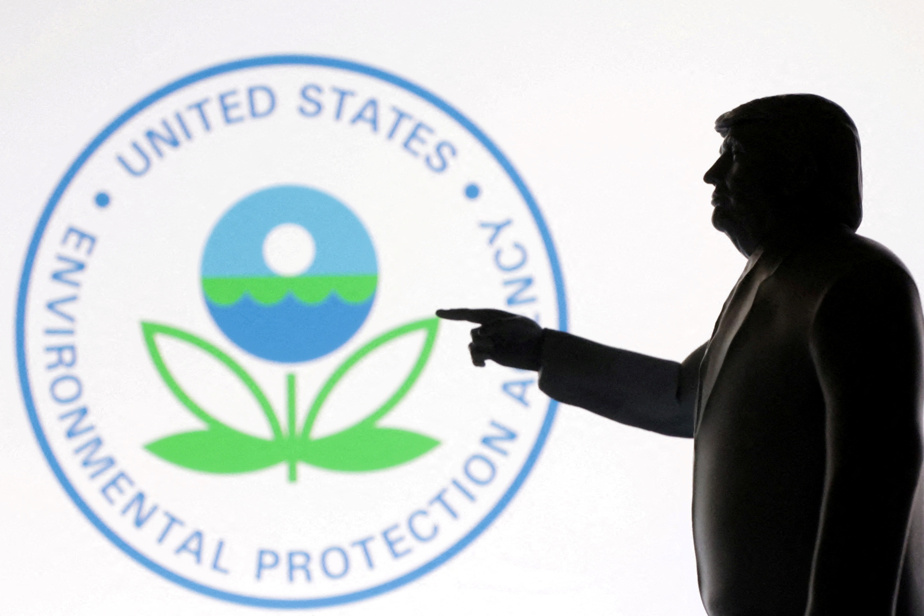
(Washington) Donald Trump will repeal on Thursday a text dating from Barack Obama and serving as the basis for the fight against greenhouse gas emissions in the United States, his spokesperson Karoline Leavitt announced on Tuesday.
Published at
The American president will “formalize the repeal” of this text dating from 2009 and called a statement of endangerment (“endangerment report”). Endangerment finding ), she told the press.
Strongly denounced by scientists and environmental defenders, such a turnaround will deal a major blow to climate action in the United States, the largest historical contributor to planet-warming emissions.
But this repeal will certainly be challenged in court and could go all the way to the Supreme Court. “We will see them in court,” Manish Bapna, president of the environmental organization NRDC, recently promised.
Adopted under the presidency of former Democratic President Barack Obama, the text stipulates that six greenhouse gases are dangerous for public health and therefore fall within the scope of pollutants regulated by the American Environmental Protection Agency (EPA).
Its adoption opened the way to numerous federal regulations aimed at limiting the release of these gases warming the atmosphere (CO2methane, etc.), starting with trucks and cars, which emit carbon dioxide by burning gasoline.
Its repeal would be accompanied by an immediate end to these standards relating to vehicle emissions and would jeopardize a series of other regulations, in particular concerning power plants.
It will be “the largest act of deregulation in the history of the United States”, assured Monday Wall Street Journal the head of the American Environmental Protection Agency (EPA), Lee Zeldin, at the origin of this effort.
The administration of Donald Trump, which strongly supports oil and coal, has sought for several months to overturn this decision and the resulting regulations.
By downplaying the role of human activities in climate change and arguing that greenhouse gases should not be treated as pollutants in the traditional sense because their effects on human health are indirect and global rather than local, the U.S. government insisted that such a repeal would lead to lower costs of cars.



