

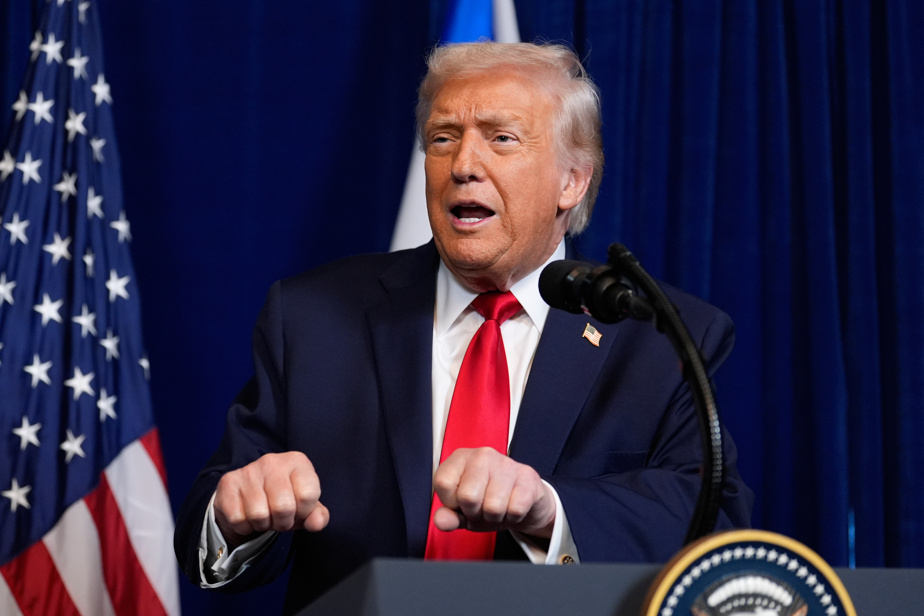
(Washington) US President Donald Trump vetoed two bills for the first time in his second term, rejecting the construction of a drinking water pipeline and the expansion of an indigenous reserve.
Published at
The Republican president vetoed these bipartisan texts on Monday, supported by elected Democrats and Republicans, the White House announced on Wednesday.
To override the presidential veto, the Senate and the House of Representatives will have to adopt these texts by a two-thirds majority.
One of these texts aimed to complete a project dating back to the 1960s to bring drinking water to the Great Plains of eastern Colorado.
Donald Trump justified his veto by the cost, according to him, of the project being too high, congratulating himself on thus sparing American taxpayers the financing of “expensive and unreliable policies”, in his letter of explanation to Congress.
The pipeline, proposed for construction in the 1960s under President John Kennedy, had the support of both houses of Congress.
“It’s not over,” wrote Colorado Republican MP Lauren Boebert, a former ally of Mr. Trump, on social media.
The White House also announced Donald Trump’s veto of a bill providing for the extension of the indigenous reservation of the Mikasuki tribe in a section of Everglades National Park, in Florida, called Osceola Camp.
The tribe participated earlier this year in legal action against the “Alcatraz of the Alligators”, a hastily set up migrant detention center in this swampy region of the Everglades.
A federal judge had ordered the dismantling of many of the center’s equipment, meaning its eventual closure.
Donald Trump said the Mikasuki tribe was not allowed to occupy Osceola Camp and that his administration would not allow taxpayer money to be used for “special interest projects,” particularly for groups “not aligned” with his migration policy.
American presidents rarely use the veto in the United States.
During his first term in the White House, Donald Trump vetoed 10 texts. His predecessor, Democrat Joe Biden, vetoed 13 bills during his four years in office.



