

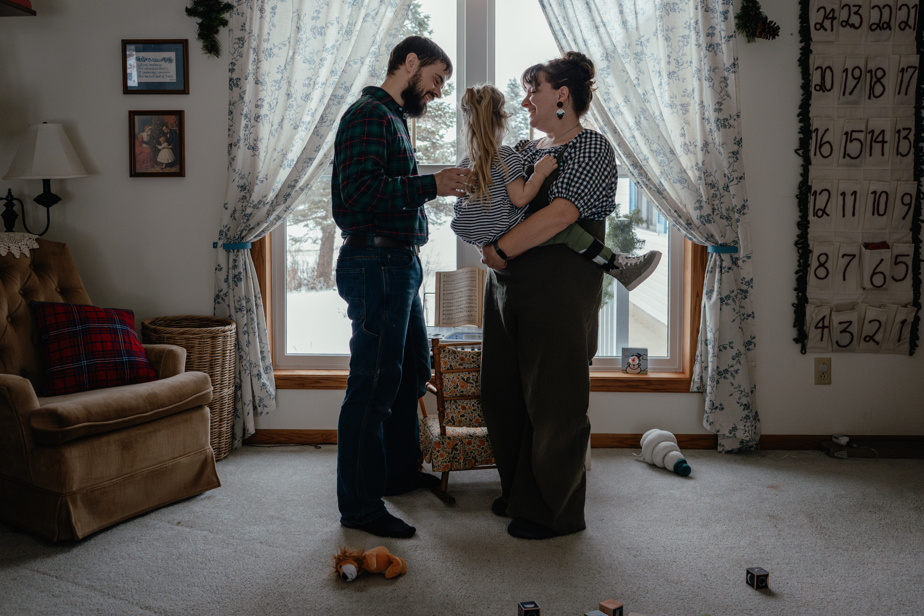
(Reedsburg, Wisconsin) Casey and Leah Garner wanted a big family: they dreamed of having at least six children by the time they were 30. But after years of infertility, the Wisconsin couple decided to adopt.
Published at
Three years ago, at the hospital, when they saw their baby, Mr. Garner was the first to notice the small growths of flesh where the ears had been. Annie, the child they adopted, was deaf.
Over the months spent with their daughter, the Garners discovered other issues: the little one had poor eyesight, a developmental disorder and muscle weakness.
As parents for the first time, they felt overwhelmed, taken by surprise in an unfamiliar world. “I was looking in all directions for anything that could help us,” said Mr. Garner, 34.
He discovered the Wisconsin Deafblind Project, a state program for families of children who are both visually and hearing impaired: it made a huge difference in how they raised Annie, the Garners say.
PHOTO JAMIE KELTER DAVIS, THE NEW YORK TIMES
Annie Garner, 3, deaf, plays the piano at her home in Reedsburg, Wisconsin, in early December.
They met other families in the same situation. They were taught tactile sign language. Annie received sensory toys and braille books. She even made a best friend, like her.
The Trump administration also canceled similar programs in seven other states – all Democratic – and in each case because the grant applications cited DEI (diversity, equity and inclusion) goals.
Donald Trump’s pet peeve
DEI is one of Donald Trump’s pet peeves, who is working to eliminate it in both the public and private sectors. Upon taking office, he signed an executive order eliminating DEI across government and all federal grants supporting the concept.
His administration has promised not to cut funding for special education. But by targeting DEI in curriculum definition, the administration has reduced its support for children with disabilities without formally targeting special education. The Department of Education says it has cut – in addition to programs for the deafblind – funding for more than 25 similar programs, including a school for the blind.
Many openly invoke racial preferences or perpetuate divisive concepts and stereotypes that no student should be exposed to.
Savannah Newhouse, federal spokesperson on canceled programs
The Garners are shaken by the elimination of federal support for the education of their deaf and blind daughter. “These are kids that everyone would want to help, right? », deplores Mr. Garner, civil engineer. “Eliminate aid for deaf and blind children? I don’t understand. »
PHOTO JAMIE KELTER DAVIS, THE NEW YORK TIMES
Mr. Garner made Annie a set of 3D printed hands that spell out their last name in sign language.
According to a letter from the Trump administration, the Wisconsin Deafblind Project was defunded because it prioritizes “applicants from underrepresented and historically marginalized groups” as well as contractors who are minorities, women or disabled veterans.
Defunded deaf-blind programs in other states have similar goals. According to Mme Newhouse, the federal spokeswoman, said the cut funds are being reinvested to “better serve students with special needs.”
One year reprieve
Calls from Wisconsin and other states for Washington to restore funding were quickly rejected. A large nonprofit, the National Center on Deafblindness, says it can draw enough money from its own federal funds to maintain the programs, but only for a year.
About 10,000 children in the United States are both hearing and visually impaired, a disability called deafblindness often caused by birth complications or genetic mutations. Most of them also suffer from other disabilities.
“For this small number, this grant was crucial,” said Jolene Gruber, an official at the Wisconsin Department of Education.
Liam Anderson, 19, has been deaf and blind since suffering meningitis and a stroke at the age of three. His mother, Jodi Anderson, remembers her first call with program staff, “one of the best phone calls of my life,” she says.
PHOTO JAMIE KELTER DAVIS, THE NEW YORK TIMES
Jodi Anderson with her son Liam, 19, who has been deaf and blind since a stroke when he was 3 years old. A counselor taught him how to use a braille transcriber.
They understood her son’s future challenges. These first contacts reassured her: Liam could still lead a happy and fulfilling life, she says.
Thanks to the program, the school board trained a teacher specializing in visually impaired people who taught the boy tactile sign language and braille.
Today, Braille books are found almost everywhere in the Anderson household. Liam’s reading these days is the book of Leviticus in the Bible.
PHOTO JAMIE KELTER DAVIS, THE NEW YORK TIMES
Jodi Anderson communicates with her son Liam, 19, who has a cochlear implant in one ear at their home in Fond-du-Lac, Wisconsin.
In high school, with the help of the counselor, he took drum lessons and was a drummer in the marching band.
A best friend for Annie
Thanks to the Wisconsin Deafblind Project, little Annie Garner found what her parents feared she would never find because of her disabilities: a best friend.
The program allowed the Garners to get to know the family of Emma, who is deaf and blind and was born nine days after Annie. From their first meeting, the two girls played together for hours; They have seen each other regularly since.
Recently, Annie was playing at her home in Reedsburg, a small rural town an hour’s drive from Madison, the capital of Wisconsin.
A multi-colored headband held her hearing aid in place, and Annie used the electronic tablet that helps her communicate, the use of which she was taught by staff at the deafblind program.
She typed several letters and symbols until her message appeared: “I am a beautiful person who is the best. »
This article was published in the New York Times.
Read this article in its original version (in English; subscription required).



