

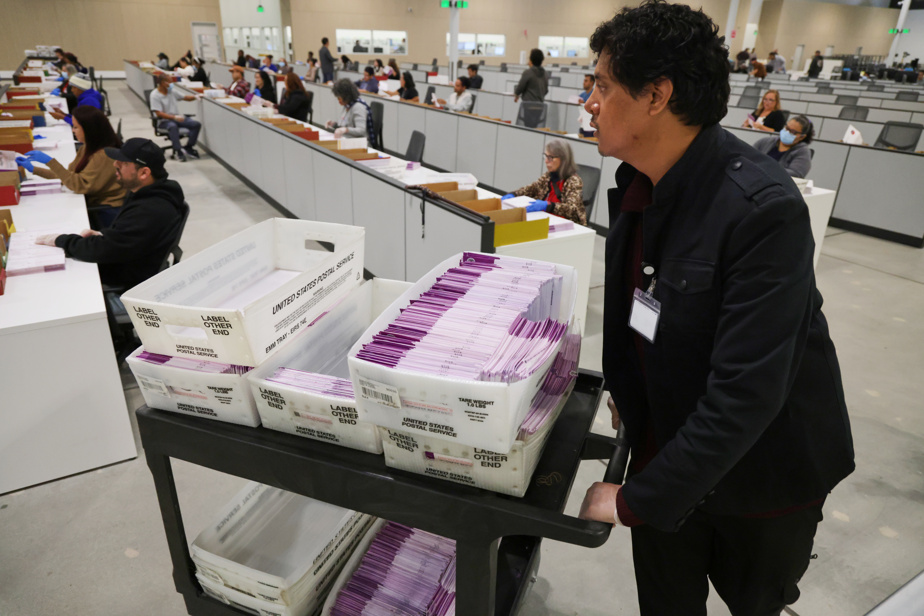
(Washington) The American Supreme Court, predominantly conservative, appeared Monday inclined to limit postal voting, by prohibiting the counting of ballots received after election day, a decision likely to weigh on the mid-term elections.
Published at
Updated to
Republican President Donald Trump, who has never acknowledged his defeat in the 2020 presidential election won by Democrat Joe Biden, baselessly denouncing massive electoral fraud, wants to ban postal voting.
Generally speaking, Republicans, supported by the Trump administration, criticize this method, which has widely developed in the United States following the COVID-19 pandemic, of encouraging fraud and, at a minimum, of fueling suspicions about the regularity of the vote and the results.
At stake Monday before the nine judges, six conservatives and three progressives: a law from Mississippi governed by Republicans which, as with around fifteen states, authorizes the counting of ballots received several days after the election, provided that they bear a postmark dated, at the latest, the day of the vote.
The Republican Party challenged this law in court. Dismissed at first instance, he won his case on appeal, the court concluding that the ballots had to arrive before the close of the poll to be counted.
The fact that ballots are accepted several days, or even more, after the election date, “undermines the idea of a uniform national election day” for the entire country, argued the Republicans’ lawyer, Paul Clement.
“Ballots arriving after the vote pose a specific problem, particularly if they tip the election,” he said. In this case “the loser, whoever he or she may be, will never accept the result, nor will his supporters,” he warned.
“Confidence in the electoral process”
Several of the conservative judges were sensitive to this argument.
One of them, Brett Kavanaugh, wondered whether the simple suspicion of fraud aroused by a reversal of the first results due to the counting of ballots arriving after the vote should be “a real concern”.
PHOTO KENNY HOLSTON, REUTERS ARCHIVES
Justice Brett Kavanaugh
“Is this something we should consider: trust in the electoral process? “, he told Mississippi Representative Scott Stewart.
He responded with the absence of significant proof of fraud via postal voting.
“States have broad powers in elections,” said Scott Stewart, recalling that ballots received after voting day have been accepted “for more than a century.”
Several of the progressive justices, including Elena Kagan, were concerned about calling into question other alternatives to traditional voting, such as advance voting, if the Supreme Court invalidated this Mississippi law.
This is one of the three notable cases concerning electoral law on the program for this session of the Court.
The other two relate to the constitutionality of an emblematic law guaranteeing the electoral representation of minorities, the invalidation of which would handicap the Democrats, and to a regulation capping campaign financing.
The nine judges should rule in these three cases by the end of their annual session at the end of June, and their decisions could therefore apply as early as the mid-term elections, four months later, next November.



