


(Providence, Rhode Island) In a classroom on a gloomy late fall afternoon, dozens of Brown University students gathered Saturday for a two-hour economics study session, full of pressing questions and pre-exam stress.
Published at
Around 4 p.m., the teaching assistant concluded by reassuring the students, many of whom were in their first semester at university: “Do your best on the final exam,” he told them. And even if you fail, he joked, it won’t change the course of your life.
Moments later, screams rang out outside the room, followed by several explosions. A door opened at the top of the lecture hall-style classroom in the Barus and Holley Engineering and Physics building.
A man dressed in black, his face covered, burst in. He shouted something incomprehensible. He carried “the longest rifle I’ve ever seen in my life,” testified Joseph Oduro, the teaching assistant.
Oduro, 21, met the shooter’s gaze. Only one thought came to his mind: bend down.
The attacker opened fire, transforming a place of learning into a scene of carnage. The attack left two students dead and nine injured at the prestigious university, authorities said, spreading terror on the campus and surrounding areas in Providence, Rhode Island.
Students spent all night locked in their dorms and university buildings, barricading themselves and trying to find out if anyone close to them had been injured or killed.
PHOTO CHARLES KRUPA, ASSOCIATED PRESS ARCHIVES
Students are escorted by law enforcement officers into a Brown University building after the shooting
Early Sunday morning, a suspect, Benjamin Erickson, 24, of Wisconsin, was taken into custody, according to two people briefed on the investigation who spoke on condition of anonymity because they were not authorized to speak publicly about the investigation.
Take shelter
For Oduro, a senior from New Jersey, this was his third time teaching Principles of Economics, a popular introductory course attended by more than 400 students.
When Oduro saw the shooter, he immediately hid behind the desk where, moments earlier, he had been encouraging around sixty students. He heard gunshots, dozens of shots, and screams.
Just before the shots rang out, Annie Johnson, a sophomore from Ohio, raised her hand to ask Oduro a question: How many points was the multiple-choice portion of the exam worth? Oduro told him to come to the blackboard so they could discuss it. That’s when Johnson heard the gunshots.
Johnson ran toward an exit, falling three times as panicked students scrambled to safety. She helped a comrade who was trampled in the melee. Johnson continued running until she reached her room.
While some students escaped through the side doors at the back of the classroom, others huddled against Oduro by the blackboard, all trying to stay as quiet as possible.
One was a freshman from Massachusetts who was shot twice in the leg. Oduro held out his hand and told him to shake it. “I told him to give me all his pain,” Oduro said. I kept telling him, “Everything is going to be okay.” »
Oduro doesn’t know how long it took the police to arrive. While they waited, Oduro spoke on the phone with the parents of the injured student, as she was in shock and had difficulty answering questions. He texted his own parents to tell them he loved them.
PHOTO MARK STOCKWELL, ASSOCIATED PRESS ARCHIVES
Emergency responders gathered on Waterman Street at Brown University.
When the police escorted Oduro and the other survivors out of the amphitheater, he was able to see the scene for the first time. There were other victims in the classroom, and he didn’t want to describe what he saw.
Oduro stayed with his injured freshman in the back of a police car the entire way to the hospital. He wanted to make sure she was okay. He knows it may sound corny, but he genuinely loved the students in that class, where he had been an assistant since his sophomore year.
He said it hurt him “to see them all in a state of panic and desperate pain.”
Across the hall from Room 166 where Oduro was leading his study session, Drew Nelson and several of his friends were studying for their final exams in another classroom. Nelson, a 19-year-old freshman from California, said they heard 10 to 15 gunshots. They hid briefly, then ran towards the exit and sprinted down the street.
At first we were disoriented. Then reality set in, we realized what had happened and we ran as fast as we could.
Drew Nelson, 19 year old student
As he ran down the street, Nelson called his mother. He and his friends spent the next 14 hours huddled in a building half a mile away.
After spending several hours at the hospital and reporting what he had seen to police, Oduro went to the house of a friend who lives off campus. Late Saturday night, law enforcement released an 11-second video showing the person they believe to be the shooter leaving the scene, dressed all in black, carrying a backpack and walking quickly. The man turns the corner of a street separating Brown’s campus from downtown Providence and disappears.
Person of interest in custody
Sunday morning, a light snow fell in Providence. It was exactly 13 years to the day since the shooting at Sandy Hook Elementary School, where 26 students, teachers and staff were killed.
PHOTO KYLIE COOPER, REUTERS
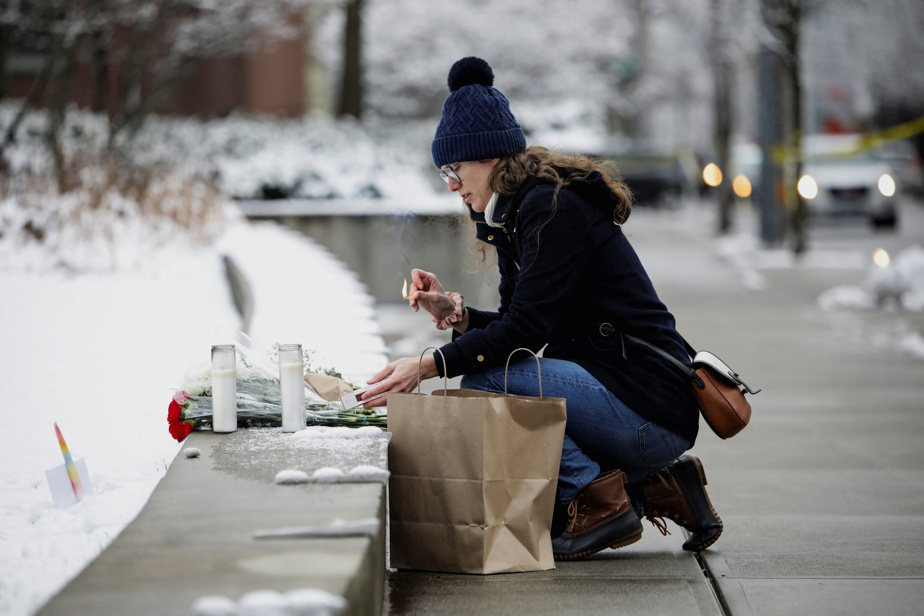
The university campus the day after the shooting
At 4 a.m., armed federal agents raided a Hampton Inn hotel about 15 miles south of Providence. They took a person of interest into custody and recovered two firearms and several magazines, according to a law enforcement official briefed on the investigation. A “person of interest” is a term used by investigators to refer to a person they wish to question and who they believe has relevant information.
Brown University announced Sunday that most remaining in-person exams and classes were canceled. Many students planned to return home as soon as possible. Oduro’s voice was calm, full of exhaustion and sadness.
He had no idea what was going to happen next. “Everyone has their own way of handling the situation,” he said. I’m just trying to be a resource for anyone who needs it. »
This article was published in the Washington Post.
Read this article in its original version (in English; subscription required)


