

Nearly every region of the United States is currently experiencing, or about to be, extreme weather.
Published at
Days of torrential rain have begun in Hawaii. The South West will soon be baking in record heat, with temperatures exceeding 38°C day after day. Two storms will dump meters of snow on the northern Great Lakes states. And the dreaded polar vortex will once again invade the Midwest and East with oppressive arctic cold.
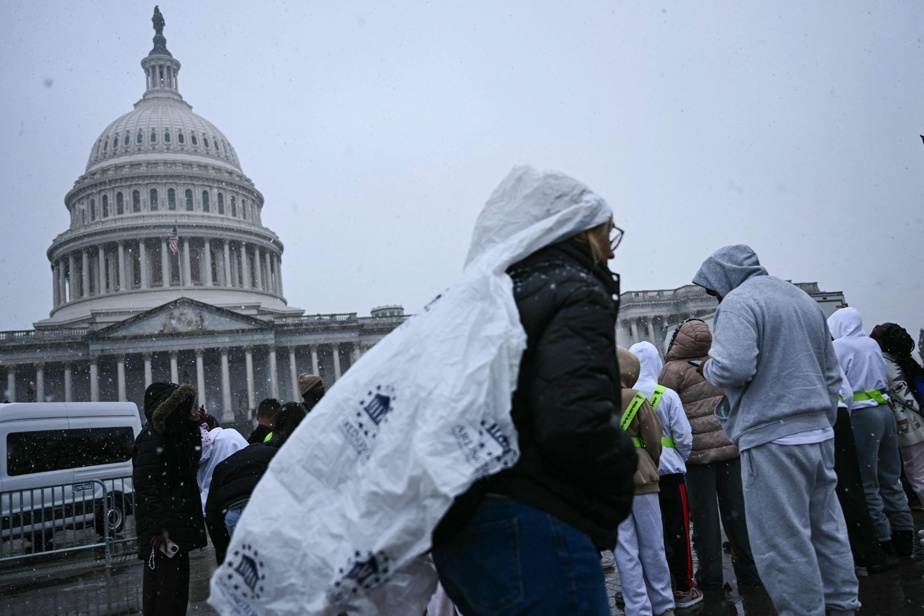
These extreme forecasts come as extreme weather has already hit much of the East. Residents of Washington, D.C., walked around in short pants in record-breaking 30°C heat on Wednesday. Thursday it snowed.
“Across the country, even if you don’t necessarily see extreme conditions, you’re going to see general changes from cold to warm, or from warm to cold to warm,” said meteorologist Marc Chenard of the National Weather Service’s Weather Prediction Center in Maryland.
Ryan Maue, former chief scientist for the National Oceanic and Atmospheric Administration (NOAA), said he expects severe weather in all 50 states.
A heat dome will form early next week and settle over the South-West, raising temperatures to levels never seen so early in the year, MM said. Maue and Chenard.
Some forecasts call for nearly 37°C in Phoenix on Tuesday, followed by two days near 42°C. In 137 years of observations, Phoenix never reached 37C before March 26 and typically recorded its first 37C day in early May, according to the weather service, which warned: “As we are not acclimated to this level of heat this early in the year, the impact will be greater than usual.”
It’s already started in Los Angeles, with unseasonably high temperatures of 32°C in March that sent people in short pants and t-shirts scrambling for shade wherever they could, even if it was as little as a lamp post.
PHOTO DAMIAN DOVARGANES, ASSOCIATED PRESS
A pedestrian holds an umbrella under bright sunshine in Los Angeles on March 12, 2026.
Around the time the heat begins to hit Phoenix, the polar vortex — a system that usually traps frigid air near the North Pole — should send its chill all the way to the heart of the Midwest and East, and even to the far reaches of the Southeast, Mr. Maue predicted.
In Minneapolis, minimum temperatures will hover around -18°C, while in Chicago they will be below 10°C on Tuesday. The next day, “temperatures will be between -10°C and -5°C in the Northeast and between -5°C and -10°C in the Mid-Atlantic region,” announced Mr. Maue. Even in Atlanta, the mercury could drop as low as -5°C.
Two consecutive low pressure systems — one on Friday, then another from Sunday to Monday — will sweep across the northern part of the country and the Great Lakes region, and could dump about a meter of snow in places, Mr. Maue said.
This second, larger low pressure system will see its barometric pressure drop so quickly and so sharply – meaning it intensifies and the winds strengthen – that it will be called an “explosive cyclone”, a fairly unusual phenomenon on earth. Normally, explosive cyclones draw their energy from warm ocean waters, but this one will draw from the polar vortex.
Just south of the Michigan region that will be hit by the heavy snowfall, a major ice storm is expected, warned meteorologist Jeff Masters of Yale Climate Connections.
An area stretching from Kansas south through Oklahoma and across Texas to the Gulf of Mexico is expected to experience strong winds in the range of 60 miles per hour, with gusts somewhat stronger Sunday evening, Masters said.
San Antonio and Austin are in the high wind zone, and places that haven’t received much rain will be at increased wildfire risk, Masters added.
Maue said Hawaii will be swept by an “atmospheric river” with torrential rains so persistent that flooding will be a major problem. Oahu is under flash flood warning.
As for Alaska, it is normally very cold at this time, but temperatures will be significantly lower than usual, he added.
This is “the time of year when we can observe this type of phenomenon,” said Mr. Chenard. “But it still seems abnormal compared to what we usually observe. By that I mean some of these regions are going to break records. Record temperatures for the month of March, and perhaps even several times. »
Over the past week, tornadoes have killed at least eight people in Oklahoma, Michigan and Indiana. Severe storm forecasts don’t look as big or widespread for next week, but dangerous thunderstorms could develop “anywhere between the Mississippi Valley and the East Coast” on Sunday or Monday, Chenard warned.
PHOTO JOEL BISSELL, KALAMAZOO GAZETTE PROVIDED BY ARCHIVES ASSOCIATED PRESS
Debris and piles of hail cover a street after flash flooding in the Belknap Lookout neighborhood northeast of Grand Rapids, Michigan, March 11, 2026.
At the origin of all this, there is a jet stream that has gone out of control, explained MM. Maue and Chenard.
The jet stream is that flow of air that moves weather patterns from west to east in a roller coaster-like path. Usually the descents are as gentle as those on a children’s roller coaster. But today, this jet stream descends almost vertical slopes that will make you scream, followed by vertical ascents.
“Which means that we observe many extremes next to each other,” analyzed Mr. Maue. Storm fronts coming from the Pacific hit that high-pressure heat dome in the Southwest and are pushed north to climb that mountain peak of the jet stream, “access that reservoir of cold air up there” and bring it back south over the other side of the hill, he explained.
Numerous studies have linked unusual jet stream and polar vortex activity to melting Arctic sea ice and human-caused climate change.
But there is hope.
“The first day of spring is (March) 20, and after that we will see improvement,” Maue predicted.



