

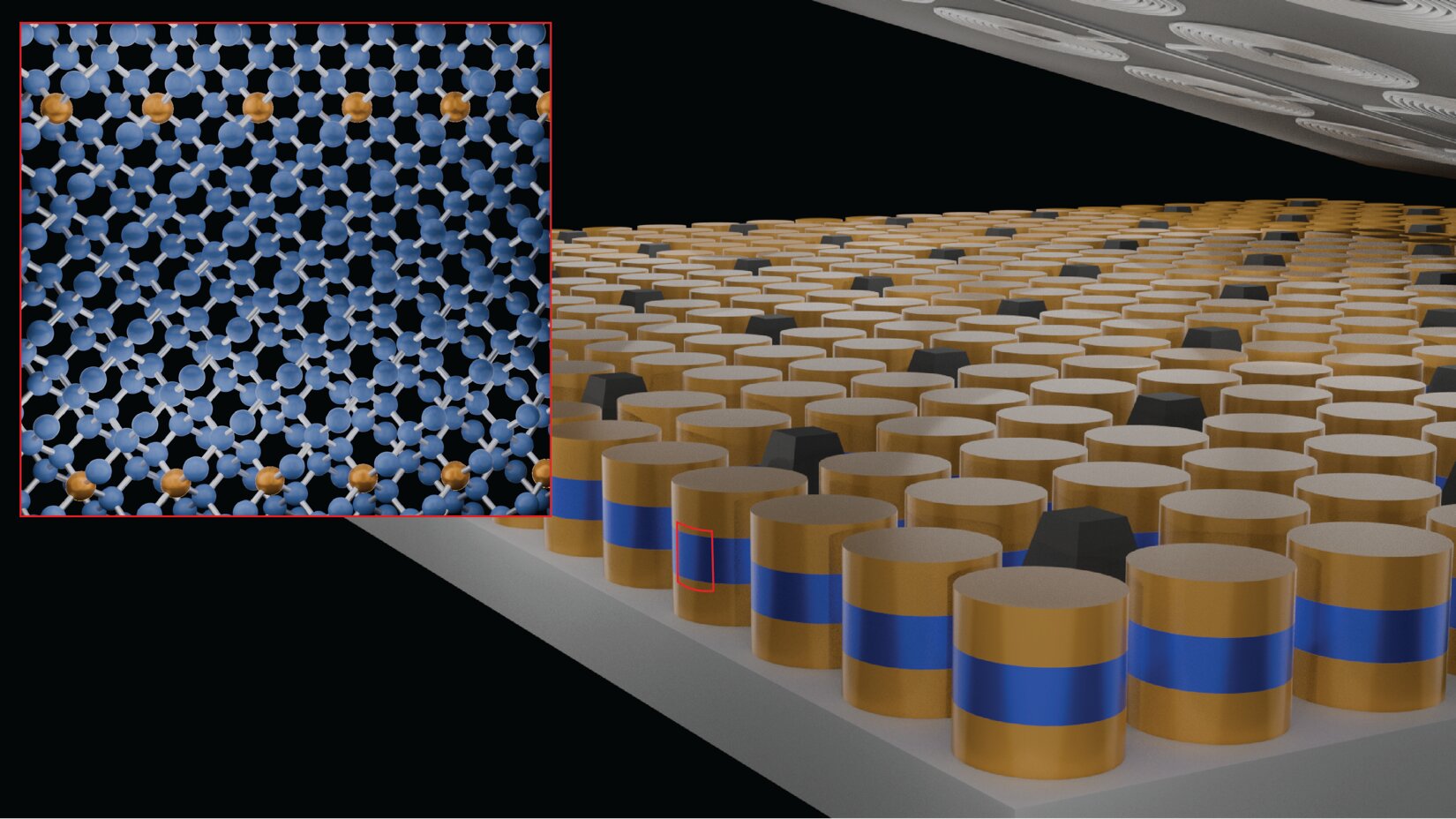
Josephson junction structures – quantum devices consisting of two superconductors and a thin non-superconducting barrier – using different forms of germanium (Ge): super-Ge (in gold), semiconductor Ge (in blue), and wafer-scale super-Ge. Millions of Josephson junction pixels (10 micrometer squares) can be created with this new material stack at wafer scale. The inset shows the crystal form of Super-Ge on the same semiconductor Ge matrix, a key to the crystal Josephson junction. Credit: Patrick Strohbeen / NYU
Scientists have long sought to make semiconductors – essential components of computer chips and solar cells – that are also superconductors, improving their speed and energy efficiency and enabling new quantum technologies. However, achieving superconductivity in semiconductor materials such as silicon and germanium has proven difficult due to the difficulty in maintaining an optimal atomic structure with the desired conduction behavior.
In an article published in the journal Nature NanotechnologyAn international team of scientists reports having produced a form of superconducting germanium, capable of conducting electricity with zero resistance, allowing currents to flow indefinitely without loss of energy, resulting in a greater speed of operation requiring less energy.
“Establishing superconductivity in germanium, which is already widely used in computer chips and optical fibers, has the potential to revolutionize many consumer products and industrial technologies,” says NYU physicist Javad Shabani, director of the NYU Center for Quantum Information Physics and the university’s new Quantum Institute, one of the paper’s authors.
“These materials could be the basis of future low-power quantum circuits, sensors and cryogenic electronics, all of which require clean interfaces between superconducting and semiconducting regions,” adds Peter Jacobson, a physicist at the University of Queensland and one of the paper’s authors.
“Germanium is already a cutting-edge material for advanced semiconductor technologies, so by demonstrating that it can also become superconductive under controlled growth conditions, there is now potential for scalable, foundry-ready quantum devices.”
Semiconductor materials such as germanium and silicon, both diamond-like crystals, are Group IV elements whose electronic behavior overlaps with that of metals and insulators. These materials are useful in manufacturing because of their flexibility and durability.
Achieving superconductivity in these elements is achieved by manipulating their structure to introduce numerous conducting electrons. These electrons interact with the germanium crystal to pair and move without resistance – a process historically difficult to control at the atomic level.
In their new work, the scientists created germanium films heavily infused with a softer element, gallium, also commonly used in electronics. This long-established process, known generically as “doping,” changes the electrical properties of a semiconductor, but at high levels of gallium the material typically becomes unstable, leading to crystal breakage and lack of superconductivity.
However, in newly reported results, scientists, using advanced X-ray techniques, demonstrate a new technique that forces gallium atoms to replace germanium atoms in the crystal at higher than normal levels. This process slightly distorts the shape of the crystal, but nevertheless maintains a stable structure capable of conducting electricity with zero resistance at 3.5 Kelvin, or approximately -453 degrees Fahrenheit, thus becoming superconductive.
“Rather than ion implantation, molecular beam epitaxy was used to precisely incorporate gallium atoms into the germanium crystal lattice,” notes Julian Steele, a physicist at the University of Queensland and one of the paper’s authors. “Epitaxy, growing thin layers of crystals, means we can finally achieve the structural precision needed to understand and control how superconductivity emerges in these materials.”
“This works because Group IV elements are not naturally superconducting under normal conditions, but changing their crystal structure allows the formation of electronic pairings that enable superconductivity,” observes Shabani.
More information:
Superconductivity in thin epitaxial layers of Ge hyperdoped with substitutional Ga, Nature Nanotechnology (2025). DOI: 10.1038/s41565-025-02042-8
Provided by New York University
Quote: Scientists create new type of semiconductor with promise of superconductor (October 30, 2025) retrieved October 30, 2025 from
This document is subject to copyright. Except for fair use for private study or research purposes, no part may be reproduced without written permission. The content is provided for informational purposes only.



