

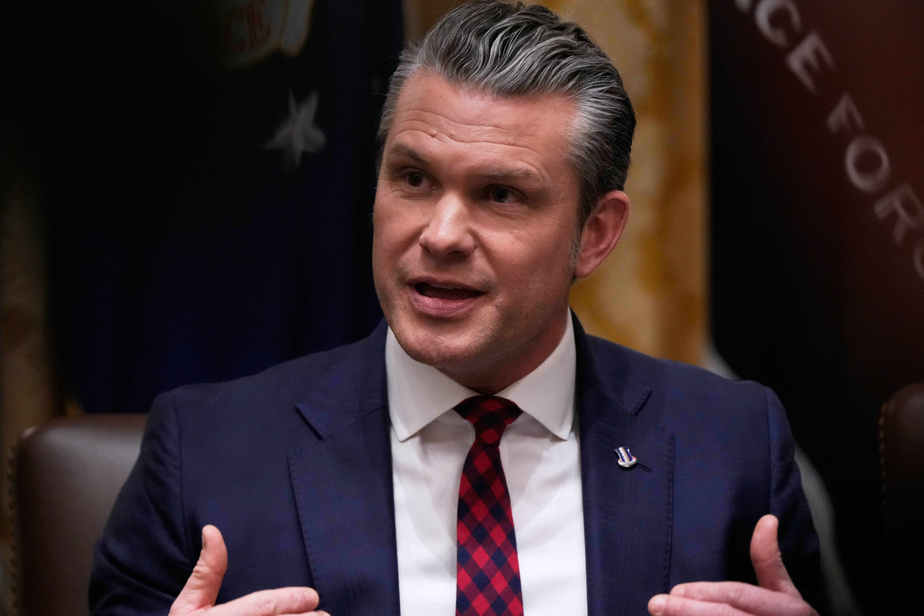
(Washington) One case after another. The American Secretary of Defense is attracting increasingly strong criticism, including from his own camp, between the contested legality of his actions and the carelessness in his use of defense secrecy.
Published on
An independent body within the Pentagon has estimated that Pete Hegseth, a former television presenter, had potentially put his troops in danger before the summer, by using Signal messaging before strikes in Yemen, American media reported on Wednesday.
Revelations which come as the legality of American strikes in the Pacific and the Caribbean against supposed traffickers is contested. No evidence has been provided and Washington is accused of carrying out extrajudicial killings.
Twice this week, according to Washington Postthe leader of the Republican majority in the Senate John Thune refrained from renewing his confidence in the secretary, believing that “others could make these assessments”.
In early 2025, Washington led a military campaign against Yemen’s Houthi rebels, in the name of protecting freedom of navigation and international trade passing through the Red Sea.
Donald Trump’s former national security adviser, Mike Waltz, was dismissed in early May, after the revelations of a journalist from the magazine The Atlanticinadvertently added to a Signal discussion group discussing these strikes.
According to the New York Timesthe Pentagon investigation reveals that Pete Hegseth’s use of Signal “potentially compromised information (…), which could have endangered personnel and missions if it had been disclosed to a foreign adversary.”
However, the investigation underlines that the secretary was legally authorized to lift defense secrecy, i.e. “a TOTAL exoneration” of the secretary, defended his spokesperson on X. “No information classified as secret was shared,” added Sean Parnell.
“Case closed,” insisted Pete Hegseth on the same network.
Frozen relationships
But today, Mr. Hegseth seems a little more on the gridiron every day.
The secretary struggles to justify an operation in September in which the US military struck the same ship twice in the Caribbean Sea, in order to kill the survivors of the first salvo.
Questioned on the subject, Donald Trump showed caution, responding on ABC that he had given the green light to the publication of images of the second strike, while indicating “not knowing” what they would show.
Does he approve of killing the survivors of the first strike? “No,” replied Donald Trump. But “I support the decision to destroy the boats”.
Since this second controversy broke out, the Trump administration has confirmed that the secretary had given the green light to Admiral Frank Bradley, commander of American special operations, a soldier with impeccable service records, to strike the boat a second time.
According to American media, the admiral must be heard by parliamentarians on the subject on Thursday. But that an officer of this stature could thus serve as a fuse for his secretary irritates the opposition, the majority and the army itself.
Relations now seem to be at their lowest point between the top brass and the Pentagon.
The secretary – and the president – have fired a significant number of senior military officials since January and did not hesitate to reprimand hundreds of generals and admirals at a meeting called in September.
“No more politically correct and authoritarian rules of engagement, make way for common sense, maximum lethality and the authority of the combatants,” said Pete Hegseth in a martial tone.
Wednesday, the Wall Street Journal affirmed that the mid-October departure of Admiral Alvin Holsey, head of military operations in the Caribbean, was not a classic retirement.
According to the daily, which cites two sources at the Pentagon, Pete Hegseth asked him to leave his functions after the gradual deterioration of their relations.



