


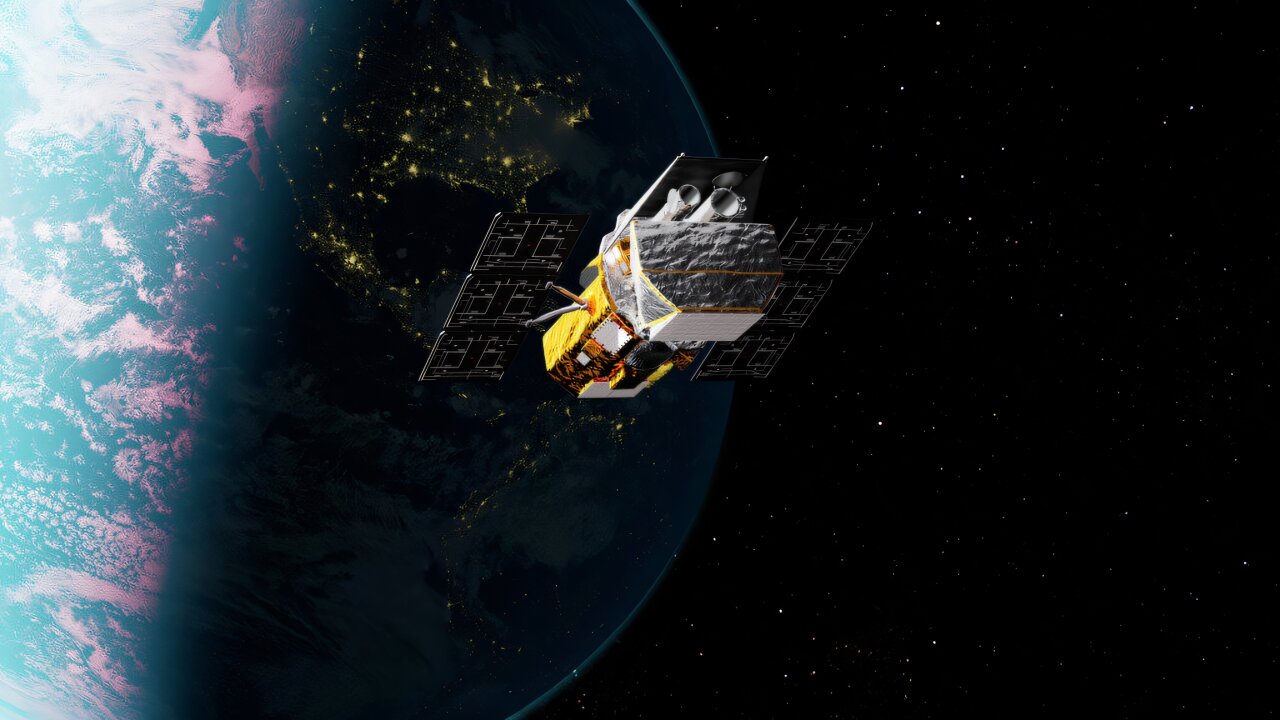
NASA’s Neil Gehrels Swift Observatory, shown in this artist’s concept, orbits Earth while studying the ever-changing universe. Credit: NASA Goddard Space Flight Center Conceptual Image Lab
Using NASA’s Swift spacecraft, an international team of astronomers carried out X-ray observations of a classical nova named Nova Scorpii 2023. Results of the observation campaign, published October 21 on the preprint server arXivprovide important information about the properties and behavior of this eruption.
A nova is a star that experiences a sudden increase in brightness and slowly returns to its original state, a process that can last several months. Such an explosion, which emits radiation at all wavelengths, is the result of the accretion process in a nearby binary system containing a white dwarf and its non-degenerate stellar companion.
Nova Scorpii 2023, also known as V1716 Sco, was detected when it erupted on April 20, 2023 at a magnitude of 8.0. Subsequent observations of this explosion confirmed it spectroscopically as a classical nova (Fe II).
Since its explosion, Nova Scorpii 2023 has been monitored regularly with Swift, which detected the X-ray emission coming from this source.
New X-ray findings reveal nova behavior
Now, a group of astronomers led by John T. Worley of the University of Wisconsin-Madison presents new results from this monitoring that shed more light on the nature of the nova. Their study was supplemented by data from the Neutron Star Interior Composition Explorer (NICER) and the Chandra X-ray Observatory.
Light curve of Nova Scorpii 2023 over 300 days of Swift observations in the 0.3-10 keV range. Eras of Chandra exposures are indicated by red dotted lines. Credit: arXiv (2025). DOI: 10.48550/arxiv.2510.19102
The study found that the supersoft X-ray source (SSS) phase of Nova Scorpii 2023 began shortly after three months after the onset of the optical flare and lasted between an additional three and six months.
The collected data indicate that the SSS flow was variable, both aperiodically and periodically. For example, between late July and September 2023, there was large, irregular variability over several days. This aperiodic variability persists but decreases in amplitude in October 2023.
White Dwarf Properties and Variability Explained
Therefore, based on these results, the astronomers assume that they captured Nova Scorpii 2023 in February 2024, at the very beginning of the cooling period, and that the total duration of the SSS phase would likely have been close to six months. This suggests a phase of constant bolometric luminosity with a total duration close to nine months, which is typical for a white dwarf with a mass of about 1.2 solar masses.
The effective temperature of the white dwarf in Nova Scorpii 2023 was estimated to be between 750,000 and 780,000 K, indicating a mass at a level of 1.1 to 1.2 solar masses. This is consistent with other estimates of massive white dwarfs in X-ray luminous novae.
The astronomers added that the irregular variability of Nova Scorpii 2023 could be triggered by clusters in the ejecta and by interactions of the flow with already emitted circumstellar material, which causes variable stages of ionization in the surrounding medium. They also found that there was no correlation between irregular variability and the amplitude of short, periodic modulations.
“The lack of correlation between SSS pulsation amplitude and total SSS flux appears to indicate two different origins for the two types of variability, possibly with periodic decreasing modulation in amplitude when the polar caps are not fully visible,” the researchers explain.
Written for you by our author Tomasz Nowakowski, edited by Sadie Harley, and fact-checked and edited by Robert Egan, this article is the result of painstaking human work. We rely on readers like you to keep independent science journalism alive. If this reporting interests you, consider making a donation (especially monthly). You will get a without advertising account as a thank you.
More information:
John Worley et al, X-ray observations of Nova Scorpii 2023 (V1716 Sco) in Outburst, arXiv (2025). DOI: 10.48550/arxiv.2510.19102
Journal information:
arXiv
© 2025 Science X Network
Quote: Nova Scorpii 2023 shows X-ray variability over several months after the stellar explosion (October 30, 2025) retrieved October 30, 2025 from
This document is subject to copyright. Except for fair use for private study or research purposes, no part may be reproduced without written permission. The content is provided for informational purposes only.


