

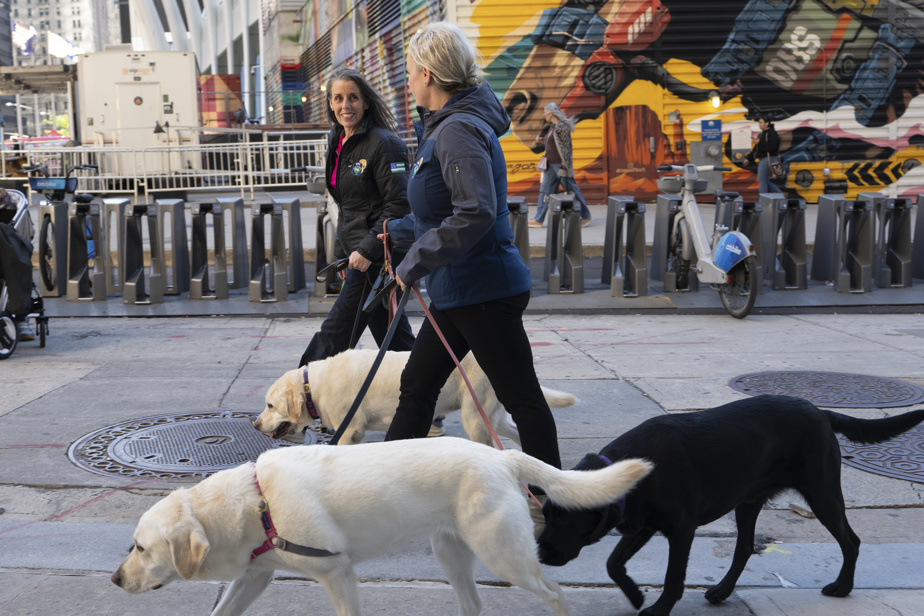
On the day four people were shot to death in a Park Avenue high-rise in July, Sergeant Karolina Ostrowska-Tuznik joined officers who had recovered the body of one of the victims, Detective Didarul Islam, there. She had brought Emma, a 2-year-old black Labrador.
Published at
The dog approached one of the police officers, who had blood on his clothes and was particularly silent. She lay down at his feet. After a while, the policeman leaned down to pet her.
Emma is part of a 24-hour animal therapy support unit that can be dispatched after the sudden death, suicide or funeral of a colleague, or during other difficult events.
The presence of a dog sometimes helps police officers to open up and verbalize their emotions, explains M.me Ostrowska-Tuznik: “Dogs have a wonderful ability to sense people’s pain,” she says.
Program under threat
But for the past year, two of the four dogs have followed their retired master; their replacement is not planned. Commissioner Jessica Tisch, appointed in November 2024, wants staff assigned to what she calls “desk work” to be redeployed to patrol. The future of Emma’s program is uncertain.
PHOTO JAMES ESTRIN, THE NEW YORK TIMES
Sergeant Karolina Ostrowska-Tuznik (in plain clothes), with the dog Emma and other police officers
Kenneth Quick, a former inspector, helped create the psychological support unit before his retirement last year. The dog program has never been unanimous, he says.
For decades, New York’s police dogs have detected bombs, drugs and dead bodies. However, pet therapy dogs “generate no arrests and solve no crimes,” says Mr. Quick.
“The priority of the NYPD (New York Police Department), with its personnel issues, is public safety,” recognizes Mr. Quick. But he adds that psychological support for officers, including the animal therapy component, is “essential to the fight against crime”.
Asked about the future of the program, a police spokesperson said it was “common for any organization to re-evaluate its performance”.
“For the past year, Commissioner Tisch has been making substantial changes to restore public confidence and ensure optimal use of agents,” said the spokesperson, according to whom the drop in recent crime “testifies to the effectiveness of this work.” In doing so, the service intends to hand over certain functions to civilians and deploy more officers on the streets.
Suicides in the New York Police Department
In 2019, the New York police launched a mental health initiative after the suicide of 10 police officers: a section composed of civilians and agents was created. The dog program followed in 2021 with two Labradors. In 2024, Emma and another dog joined the unit and there was talk of adding six more dogs and spreading them across the city’s five districts. But not anymore.
In October, a departure ceremony was held for agent Efrain Hernandez and the dog Jenny, his partner since 2021.
PHOTO JAMES ESTRIN, THE NEW YORK TIMES
Sergeant Karolina Ostrowska-Tuznik with Emma (left), Officer Efrain Hernandez with Jenny (center) and Detective Theresa Mahon with Glory at Mr. Hernandez’s retirement party
It wasn’t a typical retirement party. There were speeches and a buffet, but there were also biscuits for Jenny and two other therapy dogs, Glory and Emma, who were also given huge bones to chew on.
According to Officer Hernandez, he and Jenny may be among the last of their kind in the NYPD.
In February, another agent retired, along with his dog. An officer and another dog, Thunder, underwent two weeks of training to replace them. But then we learned that Commissioner Tisch had not approved this plan, according to a lawsuit filed by Ms.me Ostrowska-Tuznik, Emma’s dog handler.
The officer was removed from the dog team and Thunder returned to a program called Puppies Behind Bars, at an upstate prison where inmates train puppies to be pet therapy animals.
When Officer Hernandez retired, Sergeant Ostrowska-Tuznik filed two requests for the two dogs to be replaced. She never received a response.
PHOTO JAMES ESTRIN, THE NEW YORK TIMES
The pet therapy dog Emma
His own position seems uncertain. She is offered a promotion to lieutenant, but only if she leaves the psychological support section and returns to patrol.
According to an NYPD spokesperson, Mme Ostrowska-Tuznik will be able to keep Emma as a pet if she accepts her promotion.
Lawsuit for discrimination based on sex
For now, she remains in office. She sues the NYPD and Mme Tisch for discrimination based on sex, alleging that a dozen of his male colleagues were promoted without having to leave their units. Mme Ostrowska-Tuznik also says she is fighting to stay. If she left, her team would be left with just one dog, Glory, whose handler is eligible to retire.
“It almost seems like they want to close the whole section,” she said. The sergeant said she learned that her promotion was conditional on her leaving the unit on the day of the Park Avenue murders.
But the practice in the NYPD is that officers promoted to the rank of sergeant, lieutenant or captain are assigned to patrol. According to a spokesperson, less than 1% of officers promoted in 2025 remained in their units, and nine of those who did were part of specialized units already in the field, such as helicopter squadrons, underwater divers and investigation brigades.
Sergeant Ostrowska-Tuznik says she and her fellow dog handlers are specialized. In addition to two weeks of training with the dogs, they learn to intervene in crisis situations and with the families of dead or injured agents, or during highly emotional events such as the funerals of colleagues killed on duty.
Emotional sponges
Even the most caring dogs have their limits. According to Officer Hernandez, Jenny would collapse at the end of a funeral and “sleep for hours.”
“They absorb negative and positive feelings, and that’s a lot for a dog,” he says.
Mr. Quick, the former inspector, now a lecturer at DeSales University in Center Valley, Pennsylvania, calls dogs “social catalysts.”
“Police officers are very reluctant to seek help when mental health problems arise,” explains Mr. Quick. The fact that police officers and not civilians take care of the dogs makes it easier, he adds.
PHOTO JAMES ESTRIN, THE NEW YORK TIMES
During public events, dog handlers distribute cards with the name, photo and some data about each dog.
Training each dog costs $60,000, a cost covered by a partnership between Puppies Behind Bars and the New York City Police Foundation, says M.me Ostrowska-Tuznik. Dogs are also useful for bonding with the public at parties and public events unrelated to police work. Their owners distribute cards similar to hockey cards, with the name, photo and some data about each dog, such as their registration number, their weight and their date of birth.
This article was published in the New York Times.
Read the original version (in English; subscription required)



