

(New York) A miracle. A feat of engineering. The eighth wonder of the world. In 1883, all hyperboles were used to describe the longest suspension bridge in the world, which finally connected New York (Manhattan) and Brooklyn, the two largest American cities of the time.
Published at
But before becoming a phenomenon, the Brooklyn Bridge was first an idea sketched out on paper. In fact, more than 11,000 drawings preceded its construction and inauguration, illustrating the vision of its designer, the German engineer John Roebling, or detailing each of the devices necessary for the creation of this unique work.
PHOTO SYDNEY SCHAEFER, ARCHIVES ASSOCIATED PRESS
The Brooklyn Bridge, photographed on January 25 during a snowstorm
Unexpected consequence: for half a century, these drawings have themselves enjoyed a legendary status in New York. And they are resurfacing these days in this city, causing strong emotions.
“Yesterday, the director of a group I showed a number of drawings to started crying as she talked about what she was seeing,” Lindsey Hobbs, chief of conservation and preservation at the New York City Archives, said on a recent January afternoon.
“She said these drawings were just beautiful,” she added, standing in the middle of a large room where thousands of blueprints and technical drawings are stored in long, flat metal filing cabinets.
PHOTO RICHARD HÉTU, SPECIAL COLLABORATION
Lindsey Hobbs, Chief Conservation and Preservation Officer at the New York City Archives
This is what fascinates me so much. We don’t see this level of detail, this artistic sensitivity and these technical drawings anymore these days. I feel like there were some real artists on John Roebling’s team.
Lindsey Hobbs, Chief Conservation and Preservation Officer at the New York City Archives
The Metropolitan Museum of Art (Met), which shares this opinion, presents until February 22 Tea Brooklyn Bridge Up Closean exhibition of drawings of the iconic bridge originating from a scientific project proposed by the New York City Archives.
The “discovery” of a treasure
The Met exhibition comes 51 years after the announcement in the New York Times of the “discovery” of the drawings of the Brooklyn Bridge. These “priceless works of art”, to quote the Timeshad been found by chance, covered in dust and dirt, in a carpentry workshop located under the Williamsburg Bridge, not far from the Brooklyn Bridge, by a young engineer named Francis Valentine.
In 1979, historian David McCullough helped cement the myth surrounding the drawings by writing a magazine article about Valentine’s discovery.
PHOTO HYLA SKOPITZ, PROVIDED BY THE METROPOLITAN MUSEUM OF ART
Drawing representing an excavation method which was ultimately never used.
“What he found, what he saw the morning he first entered the studio, was one of the most remarkable treasures in the entire history of building art, a collection unlike any other, totaling some 10,000 original plans and drawings,” wrote McCullough, future author of a book on the history of the construction of the Brooklyn Bridge entitled The Great Bridge.
And the historian adds more by evoking what mattered most to him about this treasure: “It is the incredible care and concentration that one feels even in the smallest of these drawings, the pride, the obvious love – the love of materials, the love of the elegance of design, the love of mathematics, of lines of light and shadow, of majestic proportions, and yes, the love of drawing…”
The historian specified that an exhibition at the Whitney Museum of American Art highlighting 64 of the best-preserved drawings had been “an enormous success” in 1976.
Five years later, Brooklyn Bridgedocumentary by Ken Burns on the Brooklyn Bridge, would in turn revive interest in the drawings linked to this work, as would the centenary of the bridge in 1983.
Workers in bowler hats
Having inherited the drawings in 1976, the New York City Archives initially took charge of their preservation, cataloging and reformatting.
Over the past five years, Lindsey Hobbs and her team have dedicated themselves to cleaning them up and restoring them as needed, thanks to federal and state grants totaling $300,000.
“Some drawings are almost completely destroyed,” Lindsey Hobbs said. We have many cabinets full of fragments. We treasure them in the hope that one day we will have the time and means to restore them. »
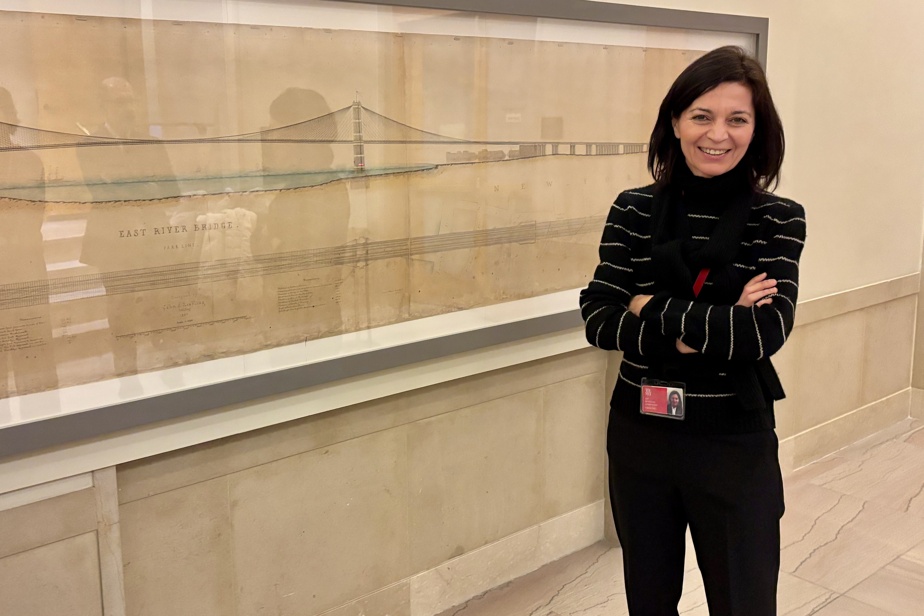
In the meantime, the New York Municipal Archives called on the Met’s scientific team to analyze six large-scale drawings in order to maximize their preservation. The most monumental of them, measuring 7.62 meters long, shows the Brooklyn Bridge from one end to the other.
Elena Carrara, an art historian and curator on the Met’s scientific team, had a reaction common to many people when seeing the drawings of the Brooklyn Bridge for the first time.
“It was a very emotional reaction, for obvious reasons,” she said in an interview along the corridor where the exhibition drawings are on display. Tea Brooklyn Bridge Up Close.
I found them magnificent. These are not simple technical drawings, but works of art. And I told myself that we had to do something to make them known to as many people as possible.
Elena Carrara, art historian and curator attached to the Met scientific team
Elena Carrara stops in front of a drawing showing the cross section of a box inside which workers, wearing bowler hats, dredge the bed of the East River by pushing wheelbarrows and wielding pickaxes. Most of these workers were Italian, Irish or German immigrants.
“I am an immigrant myself,” said Elena Carrara. For me and so many others, the Brooklyn Bridge represents a dream. And to see these workers who make this dream possible, I find it fantastic. »
Vermilion and Prussian blue
The Met’s scientific team has spent part of the last two years analyzing six drawings of the Brooklyn Bridge submitted to its attention. Thanks to its mobile laboratory and advanced techniques, including X-ray fluorescence spectrometry and Raman spectroscopy, it was able to confirm the presence of certain pigments, such as vermilion and Prussian blue.
“The drawings will not be restored to their original state,” explained Marco Leona, head of the Met scientific team. “But our work will allow conservators to determine the best way to clean the drawings, and how far to go in this cleaning, in order to regain an appearance close to the originals without causing additional damage or reducing the lifespan of the works, and without creating false reproductions. »
PHOTO RICHARD HÉTU, SPECIAL COLLABORATION
Marco Leona, head of the Met scientific team
The centerpiece of the installation Tea Brooklyn Bridge Up Close is signed by John Roebling, designer of the bridge. This is the drawing that the engineer presented to obtain approval for his project and attract the financing necessary for its completion.
PHOTO HYLA SKOPITZ, PROVIDED BY THE METROPOLITAN MUSEUM OF ART
The drawing by John Roebling
“From a technical point of view, this bridge will be second to none. It will constitute one of the most impressive and attractive assets (of New York and Brooklyn),” Roebling wrote in 1867, two years before construction began on the bridge and the premature end of his life.
His son Washington and his daughter-in-law Emily took over, relying on plans and drawings that continue to shake up New York.



