

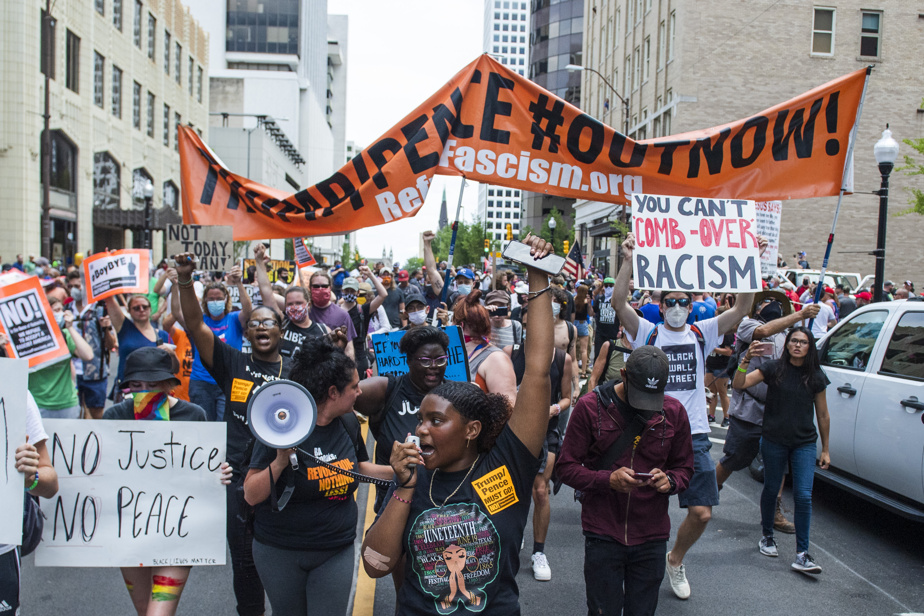
While serving in the Florida Legislature, Representative Randy Fine helped pass a law that, in certain circumstances, protects drivers who crash into protesters blocking roads.
Published at
In the United States Congress, the Republican representative has introduced a similar bill, which he calls the Thump Thump Actaimed at drivers who may encounter protesters in other parts of the country.
“When the consequences of inappropriate behavior are severe enough, people stop engaging in it,” Mr. Fine said. Blocking roads is a form of political terrorism. They should get knocked down. »
Florida is one of a dozen states that have cracked down on protests in recent years, passing laws that often equate political demonstrations with riots in a way that experts on the First Amendment to the U.S. Constitution, which governs free speech, say is illegal.
Since 2017, 23 states have adopted at least 55 laws governing the terms and conditions of protests, according to the International Center for Not-for-Profit Law, which lists these texts. These laws include a minimum sentence of 30 days in jail for rioting (often loosely defined as a group involved in tumultuous or potentially violent behavior), restrict protests on college campuses, and provide jail time and fines for people who block sidewalks, streets, and highways.
There have been few arrests or prosecutions under recently passed protest laws, but free speech advocates say the measures can be used to control or deter would-be demonstrators.
We constantly see lawmakers responding to protest movements by passing new laws that restrict the right to demonstrate.
Elly Page, senior legal advisor for U.S. programs at the International Center for Not-for-Profit Law
This conflict over protests, civil disobedience, political violence, and public safety has intensified during President Donald Trump’s second term. Trump and senior officials in his administration have repeatedly threatened to invokeInsurrection Acta law dating back centuries that allows the president to deploy the military on American soil in exceptional circumstances, in order to deal with large-scale protests.
Risk of “selective application”
Some lawyers warn that the recent push to pass laws restricting protests risks confusing free speech with violence, especially since there are already laws criminalizing dangerous behavior.
This “presents a real risk of selective enforcement,” said Anastasia Boden, senior attorney at the Pacific Legal Foundation, a libertarian-leaning law firm headquartered in Sacramento.
Florida lawmaker Randy Fine often claims that protesters blocking roads can prevent “a pregnant woman from getting to the hospital” or “adults from going to work.” When the Washington Post asked him for specific examples, he admitted that he had none to provide.
PHOTO PHELAN M. EBENHACK, ARCHIVES ASSOCIATED PRESS
Republican Randy Fine in front of a cardboard cutout of President Donald Trump after his election to the U.S. House of Representatives in April
People want to stand on the sidewalk and scream and yell all they want. Let them do it. But blocking a road is not a legitimate form of political protest.
Randy Fine, member of the United States House of Representatives
On the contrary, he described such behavior as “political violence” justifying these people “being overthrown”.
Florida law offers drivers who hit protesters far less protection than Fine often describes. The Florida Supreme Court has ruled that the law cannot apply to people who simply witness a protest that turns violent, meaning drivers are not protected if they hit bystanders who are not participating in the disturbance.
It does not grant drivers complete immunity from criminal prosecution, nor does it apply to peaceful protesters.
It also makes blocking a road during a riot punishable by up to 15 years in prison.
Emphasis on deterrence
Its defenders say no prosecutions have been filed so far under the law. That’s not the goal, according to Mr. Fine, who emphasizes deterrence and not enforcement. For him, it is about putting an end to undesirable behavior by making the consequences serious enough to discourage them.
Protest organizers nationwide have become more cautious in planning their rallies and parades because of these types of laws.
The Rev. Lee Hall-Perkins knew he was taking a risk last summer when he brought more than 100 people to a Florida college campus to protest Medicaid cuts and immigration crackdowns.
“We have anti-protest laws here,” the 36-year-old pastor said afterwards.
Most of the protests took place off campus, but he said he called ahead to request a meeting with U.S. Rep. Anna Paulina Luna, a Republican whose constituency office is on campus.
“If they want to arrest people for praying, for having a funeral procession and for donning priestly vestments, then too bad for them, because that’s going to get the attention of the nation,” said Bishop William J. Barber II, president of Repairers of the Breach and instigator of the Moral Monday protests.
This article was published in the Washington Post.
Read the original version (in English; subscription required)



