

(Los Angeles) An appeals court ruled Monday that Donald Trump had the power to deploy the National Guard in Portland, a Democratic city in the west of the United States, while the case is judged on the merits.
The court finds “that it is probable that the president lawfully exercised his statutory authority” by sending soldiers from this army reserve corps.
She thus returns to the decision of a trial judge blocking this deployment in this Oregon city that Mr. Trump described as “ravaged by war”, an analysis totally rejected by local authorities.
The Republican billionaire announced at the end of September his intention to send 200 soldiers to the city. A very controversial measure, already implemented in Los Angeles, Washington, Memphis and which his administration is also trying to use in Chicago.
In Portland, numerous demonstrations have taken place in recent months to challenge the president’s migration policy, around an immigration police (ICE) building.
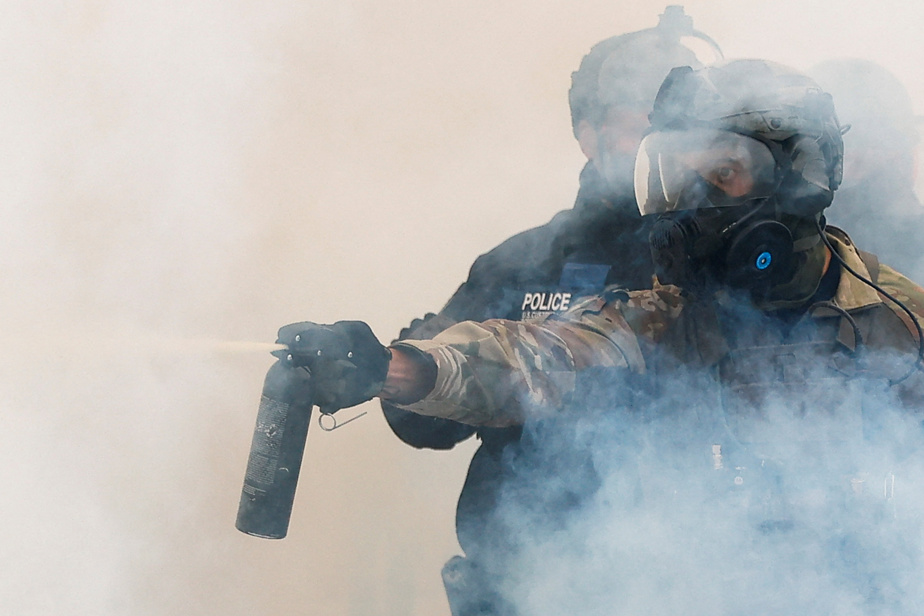
During these events, some demonstrators are disguised as unicorns or frogs and the police have sometimes used tear gas to disperse the crowds.
PHOTO JOHN RUDOFF, REUTERS ARCHIVES
A law enforcement officer pushes a protester over a bicycle in front of ICE headquarters in Portland, October 12, 2025.
These unrest are largely manageable by local law enforcement, according to Oregon Governor Tina Kotek, who has joint authority with the president over her state’s National Guard and has never found it necessary to use these soldiers.
“There is no insurrection, there is no threat to national security, and there is no need for military troops in our great city,” denounced the Democrat in early October.
“Execute the laws”
A judge initially agreed with him, temporarily blocking the sending of troops because there was no “danger of rebellion”.
But in its decision rendered Monday, two of the three judges of the court of appeal believe that Mr. Trump is within his rights. Not because there would be a rebellion, but because the president can call on the National Guard when he “is unable with the regular forces to execute the laws of the United States.”
This framework, they say, applies to events around the ICE building in Portland, where protesters interfered with the work of immigration enforcement.
An opinion contested “vehemently” by the third judge of the court, Susan Graber, who warned of a dangerous judgment for the entire United States.
“Today’s decision is not simply absurd,” she said in a dissenting opinion, recalling the incongruity of considering Portland a “war zone” when demonstrators are wearing “chicken costumes.”
“It erodes fundamental constitutional principles,” she added. Namely, “the sovereign control of states over their militias and the First Amendment rights of citizens to assemble and oppose government policies and actions.” »



