


(Minneapolis) When Jennifer Arnold learned that one of her neighbors had been arrested by immigration police, she rushed to help her family. A month later, dozens of children of Latin American origin paralyzed by fear go to school thanks to the school bus system that she set up in her Minneapolis neighborhood.
Published at
Everything changed for her in early December, when the federal immigration police (ICE) were deployed on the streets of this city located in the north of the United States and increased operations against its immigrant population.
Her neighbor’s husband was arrested by ICE. “He was taken out of his car at his workplace and taken away. I called her by chance when it happened, she answered in tears,” Jennifer Arnold told AFP.
PHOTO TIM EVANS, REUTERS
U.S. Border Patrol agents stop a car on the street during patrol in Minneapolis on Friday.
“It was overwhelming. So I helped her that weekend. She needed food, money to go shopping… And I was in contact with other families in the neighborhood who also said: “We don’t leave the house because we are not safe”. I told myself that something had to be done,” she continues.
Speaking Spanish, this 39-year-old mother, who works in an organization defending low-income tenants, is setting up a school bus system.
“At our bus stop, there are usually twenty children,” then “there were only ten,” she remembers. “A lot of families didn’t feel safe walking two or three blocks to the bus stop. I knew it was becoming unbearable. »
“Adopt a family”
“If I found someone to walk your child to the bus stop or drive them to school, would you let them?” », she asks the parents.
“We started small, with twelve children, the next week it was 18, and now I have thirty families on my list,” from different schools, as well as high school students supposed to take public buses.
Parents, neighbors, friends of friends, “people from the neighborhood accompany a child from his house to the bus stop or drive him to school, and bring him back at the end of the day.”
PHOTO KEREM YÜCEL, ASSOCIATED PRESS
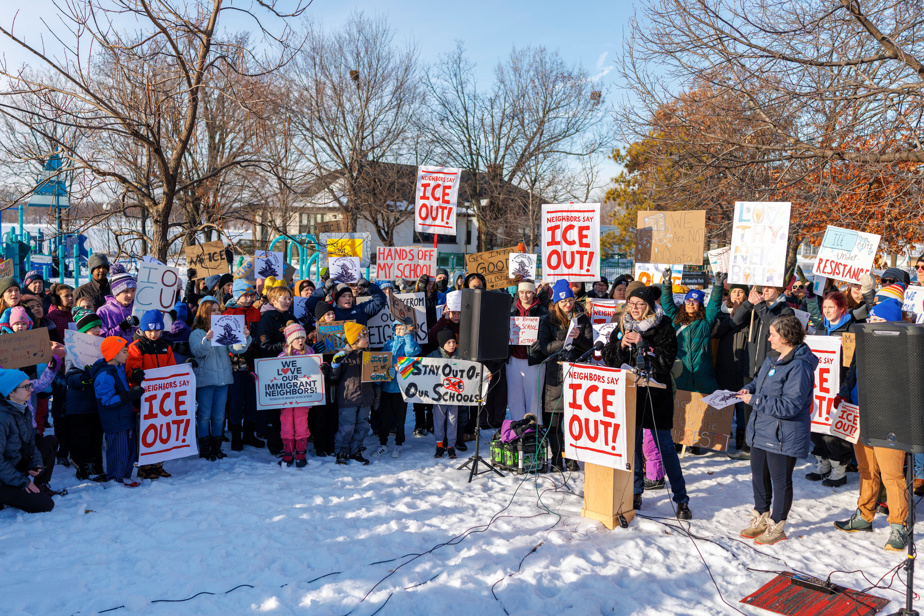
Parents and teachers rally against immigration police near Minneapolis schools
When the Christmas holidays arrive, Jennifer Arnold takes over at the school and, in turn, organizes food distributions.
“Do you want to adopt a family?” », she says to households spared by the ICE threat. “They went shopping for the family they had adopted,” and “delivered them just before Christmas and New Years. These families told me, ‘My children would have been hungry,’” otherwise.
The death of Renee Nicole Good, a 37-year-old American mother who was shot dead on Wednesday by an ICE agent in a residential area of Minneapolis, generated a surge of solidarity.
Whistle
“I introduced a four-year-old child to a neighbor who will take him home every day. And all these people in the street were asking, “Can we do this too?” Since then, my list has grown,” appreciates Jennifer Arnold.
Natasha Dockter, manager in the Minneapolis educational community, no longer goes out without her whistle around her neck, just like “most of (her) neighbors”. “We whistle as soon as we see the immigration police to alert the community” of their presence, she describes to AFP.
PHOTO TIM EVANS, REUTERS
Immigration police officers mobilized in Minneapolis
This whistle, which she uses “more often” than she would like, is also “a symbol” for the ex-teacher. “An invitation to talk between neighbors about what’s happening,” she explains. I always have a few whistles in my pocket to hand out. »
The school is also organizing in the face of anti-immigration pressure. Minneapolis announced Friday that it would launch distance learning until mid-February for students who need it.
Young people who are not directly exposed also suffer from the situation.
“There are children who have lost a family member, who are terrified, completely traumatized, who only go out to go to school, and there are our children to whom we have to explain these tragedies,” laments Becca Dryden, a thirty-year-old mother. “It is a trauma that affects all our children. »


