

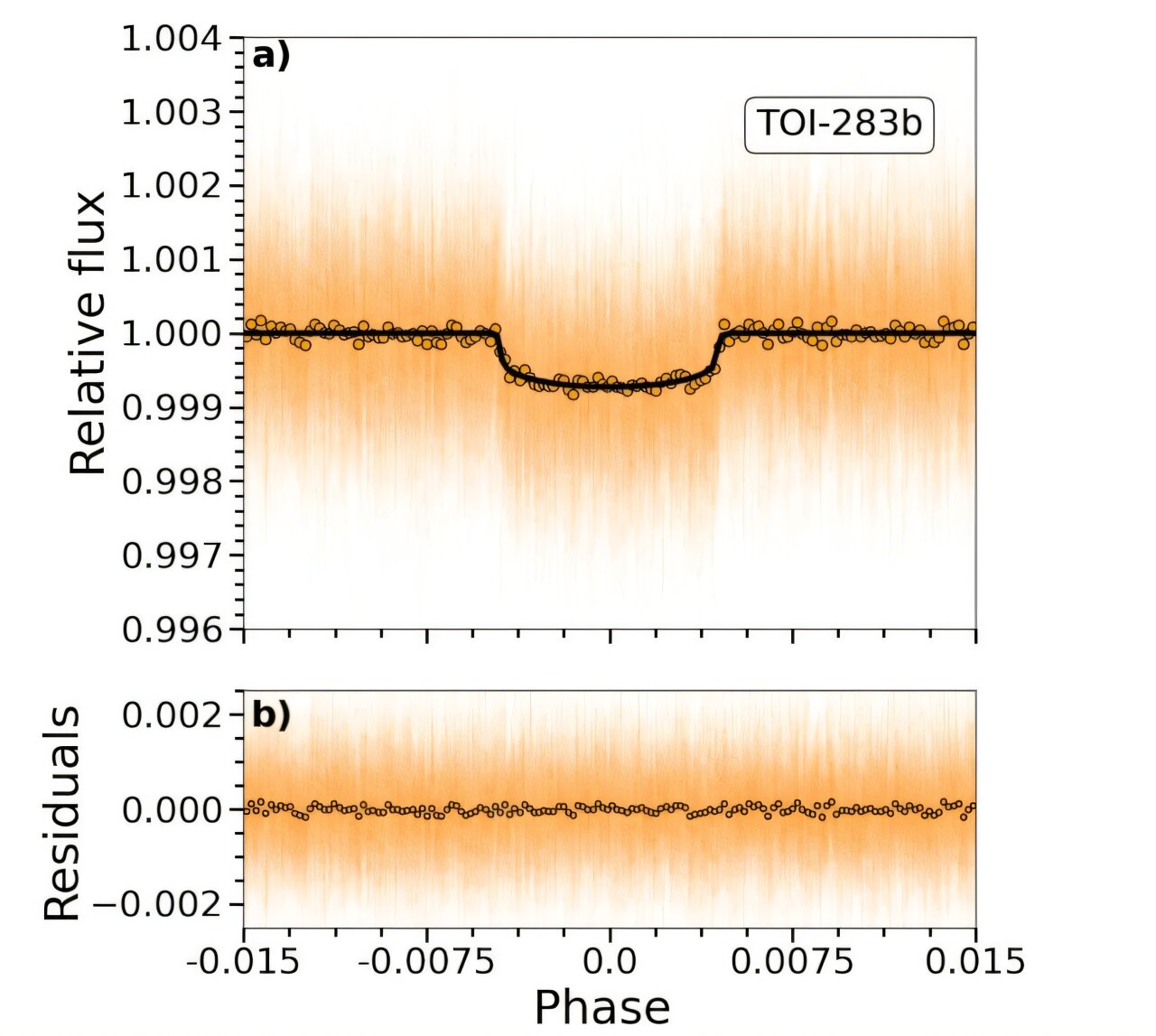
Phase-folded TESS data from TOI-283 b. Credit: arXiv (2025). DOI: 10.48550/arxiv.2510.15084
Using NASA’s Transiting Exoplanet Survey Satellite (TESS), an international team of astronomers has detected a new exoplanet orbiting a bright K-type star known as TOI-283. The new alien world, which received the designation TOI-283 b, is about 40% smaller than Neptune. The discovery was detailed in a research paper published October 16 on the preprint server. arXiv.
TESS searches for extrasolar worlds transiting bright, nearby stars. To date, it has identified more than 7,700 candidate exoplanets (TESS Objects of Interest, or TOI), and 705 of them have been confirmed by follow-up observations.
Located about 269 light years away, TIC 382626661 is a bright K-type star about 15% smaller and 20% less massive than the Sun. The star has been observed with TESS since 2018, which allowed the detection of a transit signal in its light curve and it received the designation TOI-283.
A group of astronomers led by Felipe Murgas of the University of La Laguna, Spain, carried out follow-up photometric and spectroscopic observations of TOI-283 using ground-based facilities including the Very Large Telescope’s (VLT) Echelle Spectrograph for Rocky Exoplanets and Stable Spectroscopic Observations (ESPRESSO). The observation campaign confirmed the planetary nature of the previously identified signal.
“The candidate planet was first detected by NASA’s TESS mission; ground-based observations confirmed that the star has no detectable stellar companions and that transits occur on the star TOI-283. High-precision RV (radial velocity) measurements made with the VLT’s ESPRESSO instrument helped determine the mass of the candidate planet,” the scientists explain.
Observational results indicate that TOI-283 has a radius of approximately 2.34 Earth radii and is approximately 6.54 times more massive than Earth, giving a density of 2.81 g/cm.3. The planet orbits its host every 17.62 days, at a distance of approximately 0.12 AU from it. The planet’s equilibrium temperature has been calculated to be 661 K.
Therefore, based on its physical properties, TOI-283 has been classified as a mini-Neptune. The paper’s authors noted that TOI-283 b’s position in the mass-radius diagram and theoretical compositional models indicate that this planet has a significant contribution of light elements and is consistent with an extended hydrogen/helium-rich atmosphere and/or significant water content.
Further observations of this planet with the James Webb Space Telescope (JWST) are suggested to confirm the presence of water in its atmosphere.
As for the parent star TOI-283, the data collected indicates that it has an effective temperature of 5,213 K and an iron abundance at a level of -0.09 dex. The age of the star is estimated at 10.4 billion years.
Written for you by our author Tomasz Nowakowski, edited by Sadie Harley, and fact-checked and edited by Robert Egan, this article is the result of painstaking human work. We rely on readers like you to keep independent science journalism alive. If this reporting interests you, consider making a donation (especially monthly). You will get a without advertising account as a thank you.
More information:
Murgas et al, TOI-283 b: A mini-Neptune in transit on a 17.6 day orbit discovered with TESS and ESPRESSO, arXiv (2025). DOI: 10.48550/arxiv.2510.15084
Journal information:
arXiv
© 2025 Science X Network
Quote: Mini-Neptune exoplanet orbiting a bright K-type star discovered with TESS (October 30, 2025) retrieved on October 30, 2025 from
This document is subject to copyright. Except for fair use for private study or research purposes, no part may be reproduced without written permission. The content is provided for informational purposes only.



