

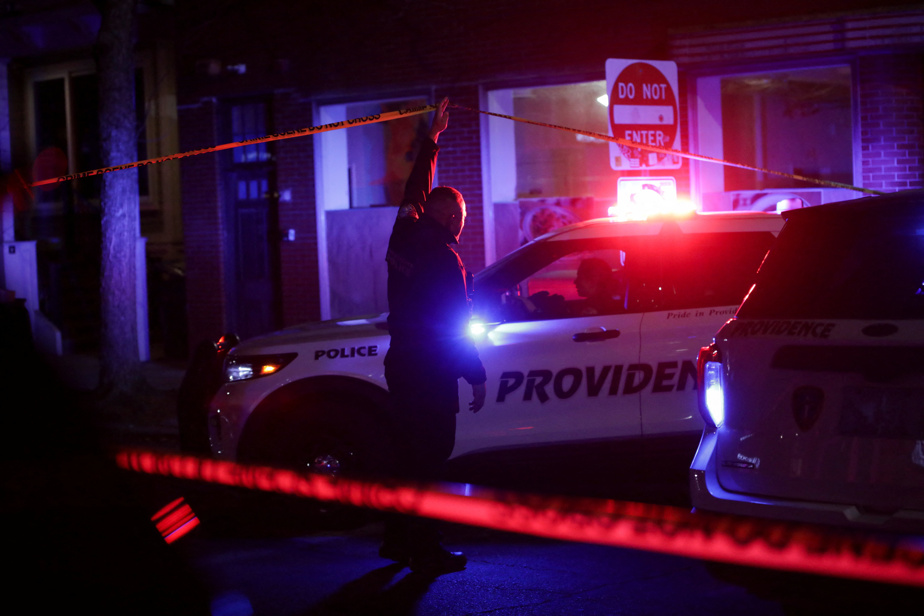
While the United States remains the country where mass shootings occur most frequently in the Western world, their numbers are now at their lowest in two decades.
Published at
“Mass shootings have fallen by more than 50% in the last two years, it’s more than a small drop,” comments James Alan Fox, criminologist and professor at Northeastern University in Boston. He maintains the university’s mass shooting database, maintained in conjunction with the Associated Press and USA Todaysince its launch in 2006.
So far this year, there have been 17 mass shootings in the United States, attacks in which at least four people were killed – not including the killer – during one event over a 24-hour period. Last year, their number was 38.
These figures include domestic murders. If we only take into account killings in public places, committed by firearm or otherwise, the figure rises to seven this year.
Criteria
Given the criteria, violent attacks escape this database. This is particularly the case of the one that occurred at Brown University on Saturday, in which two people were killed and nine others injured. And the shooting at a Minnesota church in August, during which around twenty people – mostly children – were injured and two students aged 8 and 10 died.
PHOTO LIAM JAMES DOYLE, THE NEW YORK TIMES ARCHIVES
Candlelight vigil for victims of the August 27, 2025 shooting in Minneapolis, Minnesota
“There really isn’t a perfect definition,” says Adam Lankford, an expert on mass shootings at the University of Alabama. In the case of an active shooter, the FBI considers intent, but it’s also imperfect because you can’t always tell. »
The number of mass shootings has also declined in the United States, being at its lowest since 2018, according to the Gun Violence Archive. It went from 503 in 2024 to 393 so far in 2025.
“The decline in the number of mass shootings, particularly when looking at the first six months of the year, is consistent with other data; we see a decline in the first half of 2025 in violent crimes, notes Mr. Lankford. It’s hard to know exactly why, given the number of variables. »
Response and prevention
The experience of mass killings allows for better care of victims and threats, specifies Mr. Lankford. “We have a better understanding of the best way to respond quickly to these tragedies,” he explains. For example, I know that some police forces are trained to put gunshot victims in their car and quickly drive them to a trauma center. Because we assess that the chances of survival are better than waiting for an ambulance. »
“One positive thing, from my own research, is that we are seeing an increase in threats in schools, but also a significant decrease in shootings,” says Eric Madfis, of the University of Washington in Tacoma. I think this is partly attributable to the increased use of threat assessment tools in schools, which are increasingly mandatory. »
Eleven states, including Texas and Florida, require schools to have a team for threat assessment programs, including to try to prevent school shootings.
PHOTO DAKOTA SANTIAGO, THE NEW YORK TIMES ARCHIVES
Police officers at the scene of a mass shooting in which a shooter killed four people, in Manhattan, July 28, 2025
Reasons behind the decline
It is difficult to isolate factors to explain the drop in the number of mass killings, underlines Mr. Fox, especially since each state has different laws on firearms. “Studying the legislative provisions in 11 different states, we found that there are decisions that have a significant impact on the number and severity of public mass shootings by firearm,” he says. States that require a license for purchase with a more meticulous background check have significantly fewer. Just like those that ban high-capacity magazines, with a limit usually set at 10 rounds. »
He also evokes Isaac Newton: what goes up must come down. After years of growth, a decline is not surprising in his eyes.
“Unfortunately, that means we’re probably going to see another increase in 2026, even if I don’t want that; the challenge is to ensure that the increase is not too significant,” he adds.
Are mass killings guided by the laws of nature? “We have the capacity to eliminate mass shootings, but we will not,” responds Mr. Fox. We could confiscate all the weapons. Arrest all those who scare us, those who publish horrors on the internet and spread hatred. We could legislate and ban all violent video games and anything considered a problem. But we won’t. Because we cherish our individual freedoms and, unfortunately, these crimes are one of the prices we pay for those freedoms. »
The American newsletter will take a break during the holiday season and will be back on January 6.



