

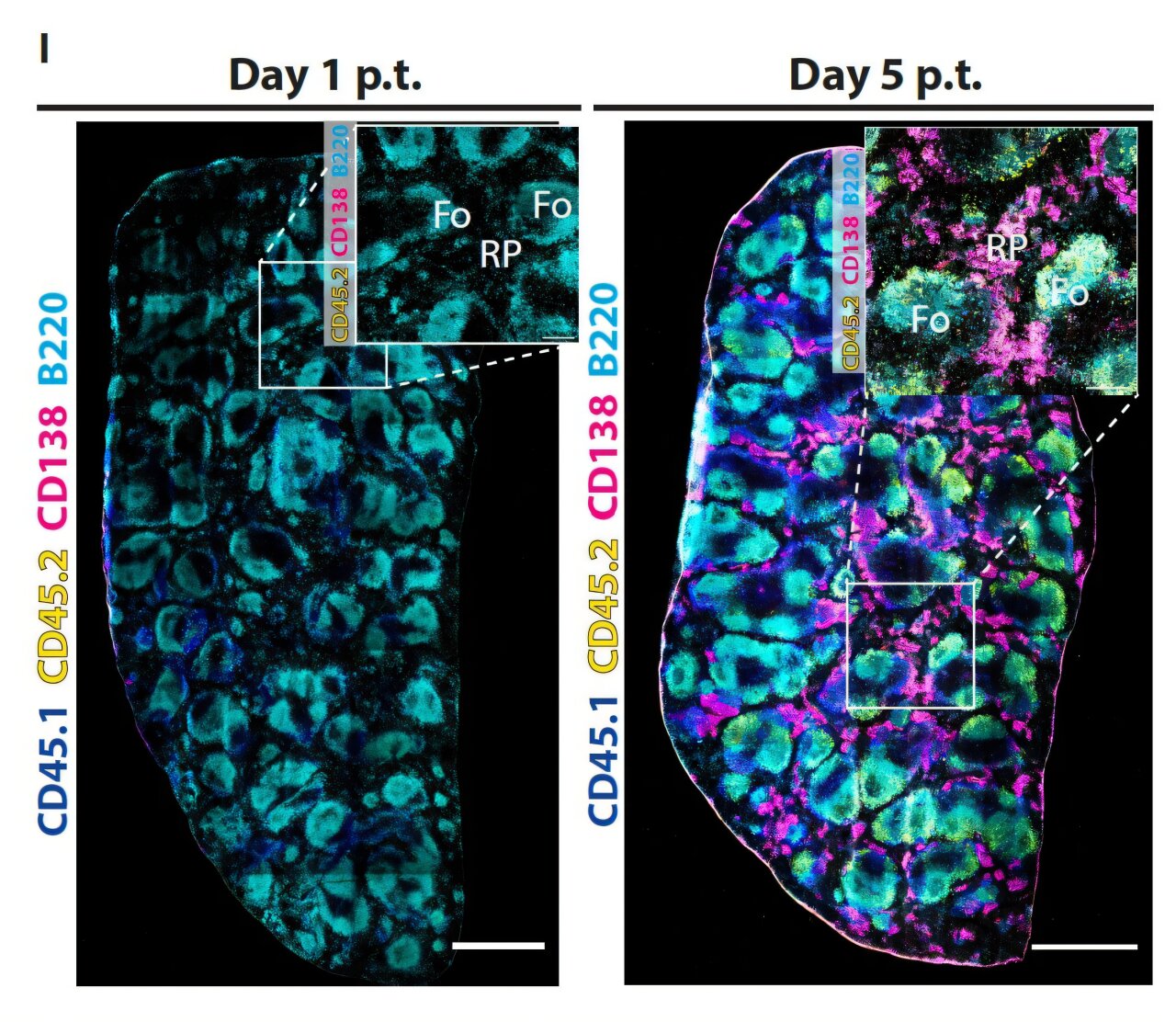
Representative IF images of the whole spleen at 1 and 5 dpt CD45.1 channel removed in insets with colors as in (G). Scale bars, 1 mm and 200 μm (inset). Credit: Danni Y. Zhu
Our body’s immune system quickly springs into action when it detects a foreign body that shouldn’t be there. Sometimes the same defense mechanism can become confused and end up attacking the very cells it’s supposed to protect, a phenomenon known as an autoimmune response.
Lupus, a chronic inflammatory disease in which the immune system attacks healthy tissues, causing damage and inflammation in different parts of the body, is the result of such autoimmune responses.
In a recent study, researchers found that CD21, a protein found on mature B cells that helps them recognize and respond to pathogens, can actually trigger the autoimmune activity that triggers lupus. Therapeutic targeting of CD21 could be a viable approach to suppress B cell autoreactivity.
The researchers say the scope of their findings can be extended to areas such as aging and infections, where similar B cell reactivity has been documented. The report was published in Scientific immunology.
Not just a rash
Lupus gets its name from the wolf bite-like rash associated with the disease, but its impact goes beyond the skin. This disease, which affects more than 5 million people worldwide, can cause significant damage to joints and even essential organs like the heart, kidneys and brain.
Lupus has been written about and discussed since the time of Hippocrates in 460 BC, but it was not until 1941 that the disease was classified as an autoimmune disease. Since then, researchers around the world have been trying to identify the biological mechanisms underlying the autoreactive response and what can be done to mitigate its effects.
Studies have shown that autoantibodies that attack the body’s own cells are created by B cells as they mature rapidly via a shortened pathway known as the extrafollicular (EF) pathway. Although it is known that the EF pathway generates pathogenic B cells, little is known about how they are generated or how they interact with other components of our immune system.
-
CD21lo cells are derived from CD21+ cells and are potent producers of ASC and autoantibodies. Credit: Sci. Immunol. (2025).DOI:
-
Negative regulation of CD21 during proliferation is inhibited by functional blockade of the receptor. Credit: Sci. Immunol. (2025).DOI:
Focus on the therapeutic target
To study autoreactive B cells, the researchers in this study created a controlled model using mice genetically engineered to have an autoimmune environment enriched with autoantigens. The team then introduced new B cells into the mice and observed how they transformed into harmful cells. The observation revealed that the process was highly dependent on TLR7, an immune sensor known to trigger autoimmune reactions.
They also found that when CD21 binds to its natural complement molecules – a group of proteins that work together to fight infection – its amount on the surface of B cells decreases, and this decrease causes the B cell to become an autoantibody-secreting cell (ASC).
When an antibody was used to block CD21 function, they observed downregulation and reduced production of ASC. The researchers believe this technique could be used to develop therapeutic strategies to treat autoreactive B cell responses.
This study identified CD21 not only as an initiator of TLR7-driven autoimmune proliferation of EFs, but also as a promising entry point for the development of safer and more precise lupus therapies.
Written for you by our author Sanjukta Mondal, edited by Gaby Clark, and fact-checked and revised by Robert Egan, this article is the result of painstaking human work. We rely on readers like you to keep independent science journalism alive. If this reporting interests you, consider making a donation (especially monthly). You will get a without advertising account as a thank you.
More information:
Danni Y. Zhu et al, CD21 initiates extrafollicular differentiation of autoreactive B cells in a TLR7-driven lupus model, Scientific immunology (2025). DOI: 10.1126/sciimmunol.ads8226
© 2025 Science X Network
Quote: Downregulation of CD21 triggers harmful B cells in lupus (November 18, 2025) retrieved November 18, 2025 from
This document is subject to copyright. Except for fair use for private study or research purposes, no part may be reproduced without written permission. The content is provided for informational purposes only.



