

(Aboard Air Force One) Donald Trump reiterated Friday his intention to resume nuclear weapons testing, without however disambiguating what exactly he meant by this announcement which has sparked concern and protests around the world.
When an AFP journalist asked him if he was talking about carrying out an underground nuclear explosion, which the United States last did in 1992, the American president replied: “I’m not going to say that.”
“You will know very soon, but we will do some testing, yes. Other countries do it too. If they do it, we will do it too,” he said aboard the presidential plane Air Force One.
PHOTO ELIZABETH FRANTZ, REUTERS
US President Donald Trump speaks to the press aboard Air Force One on October 31, 2025.
On Thursday, he announced that he had ordered the Pentagon to “begin testing our nuclear weapons on an equal footing” with Russia and China.
Doubt has remained ever since – intentionally or not – about his remarks: is he talking about testing weapons capable of carrying a nuclear warhead or about the actual detonation of a nuclear charge?
His shock decision sparked strong protests around the world. The last to react, Iran, accused by the West and Israel of developing atomic weapons despite its denials, judged that the United States represented “the most dangerous proliferation risk in the world”.
It is a “serious threat to international peace and security”, declared on X the head of Iranian diplomacy, Abbas Araghchi. “The world must come together to hold the United States accountable,” he added.
“Credible deterrence”
Japanese survivors of the bombs of Hiroshima and Nagasaki in August 1945, the only instances of the use of the supreme weapon and symbol since of absolute military taboo, joined the protests.
Donald Trump’s remarks go “against the efforts made by nations to build a peaceful world without nuclear weapons and (are) absolutely unacceptable”, denounced the Nihon Hidankyo organization in a letter to the United States embassy in Japan.
In Kuala Lumpur, where he had just met his Chinese counterpart, the American Secretary of Defense, Pete Hegseth, justified the decision on Friday by the need to have a “credible nuclear deterrent”.
PHOTO EUGENE HOSHIKO, REUTERS ARCHIVES
US Secretary of Defense Pete Hegseth
“Resuming the tests is a fairly responsible, very responsible way of doing it,” he said, without clarifying what type of tests it would be.
No power has officially carried out a nuclear test for three decades – with the exception of North Korea (six times between 2006 and 2017). Russia (then the Soviet Union) has not operated one since 1990, and China since 1996.
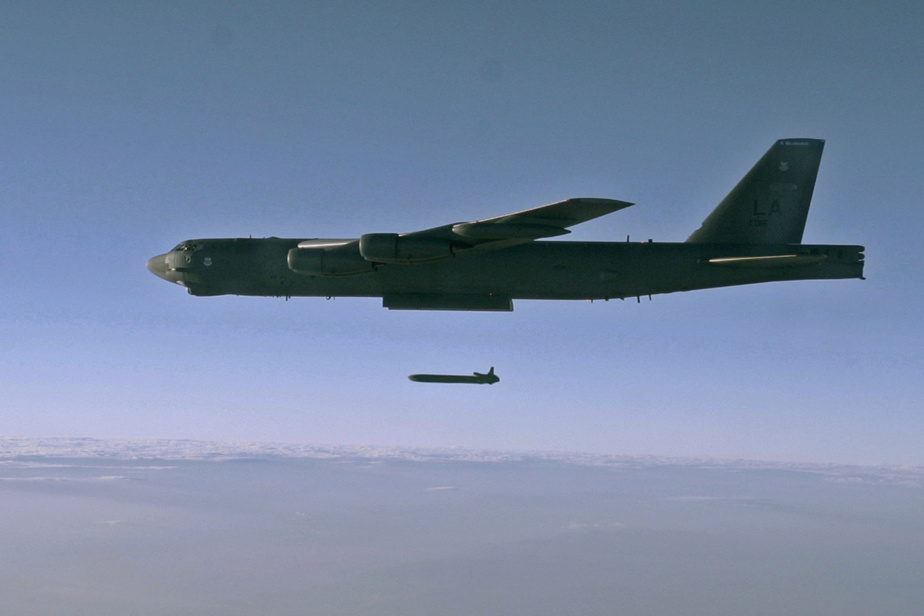
But many countries, led by the United States, regularly carry out tests of missile vectors, submarines, fighter planes and others.
According to the Stockholm International Peace Research Institute (SIPRI), Russia has 4,309 nuclear warheads deployed or stored, compared to 3,700 for the United States and 600 for the Chinese. These figures exclude warheads intended for dismantling.
“Reckless climbing”
Washington’s announcement comes in an incandescent geopolitical context, and as nuclear rhetoric periodically comes to the fore since Russia’s invasion of Ukraine in February 2022.
These tests “must never be allowed,” insisted Thursday Farhan Haq, deputy spokesperson for UN Secretary-General António Guterres. “We must not forget the disastrous legacy of the more than 2,000 nuclear tests carried out over the past 1980 years.”
Washington is a signatory to the Comprehensive Nuclear Test Ban Treaty (CTBT). Carrying out a nuclear explosion would constitute a blatant violation.
Donald Trump’s decision responds to Moscow’s maneuvers: this week, Russian President Vladimir Putin welcomed the successful final test of a cruise missile with “unlimited range”, then that of an underwater drone, two nuclear-powered devices according to Moscow.
But the Kremlin clarified Thursday that these were tests of weapons capable of carrying a nuclear charge and not of the bombs themselves, saying it hoped “that President Trump was informed correctly.”
Beijing, for its part, expressed the hope that Washington “seriously” respects its international obligations and takes “concrete measures to preserve the global disarmament and non-proliferation system.”
The International Campaign to Abolish Nuclear Weapons (ICAN), Nobel Peace Prize winner in 2017, deemed American intentions “unclear” and denounced “an unnecessary and reckless escalation of the nuclear threat”.



