

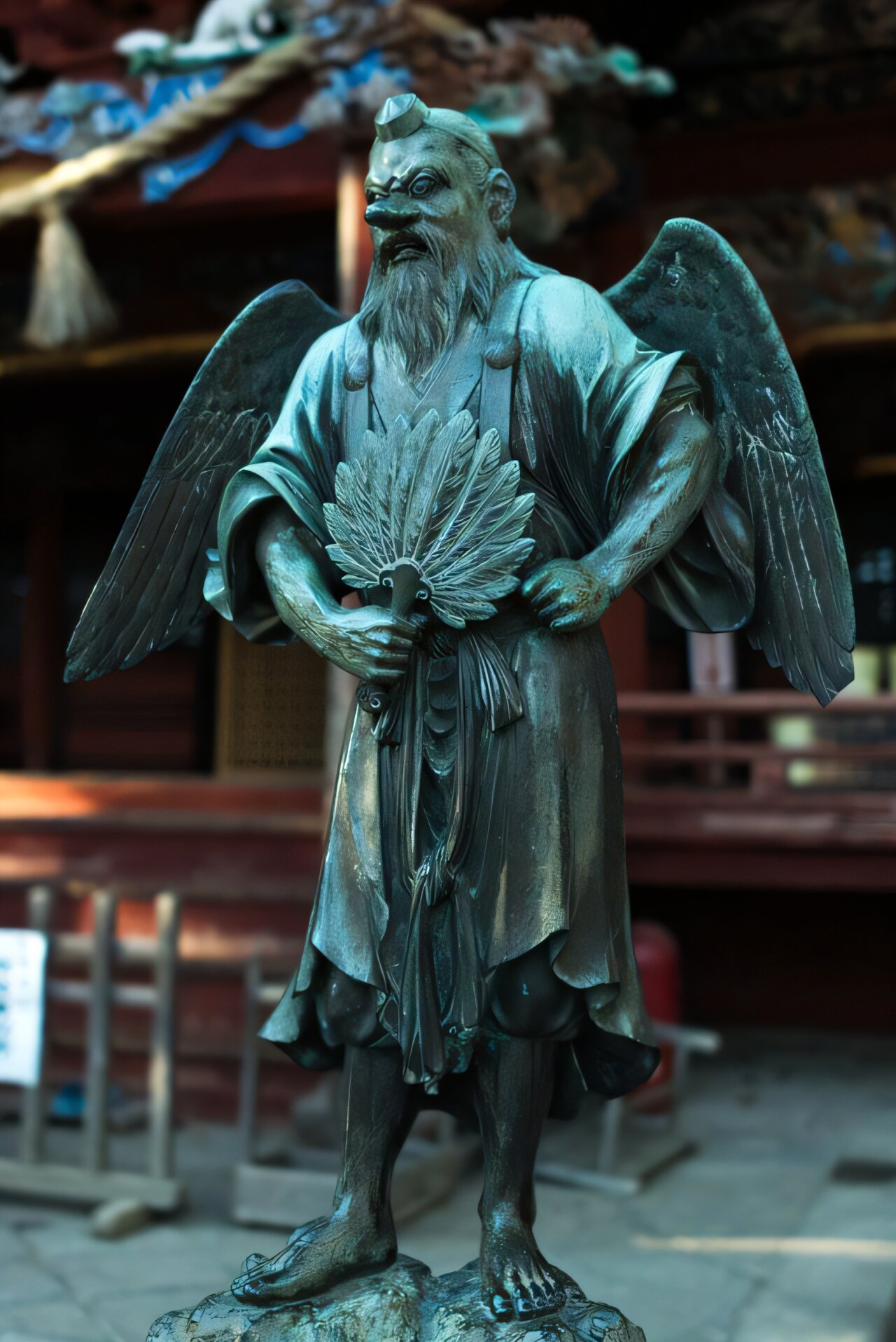
In Japanese folklore, tengu are supernatural beings who inhabit mountains and deep forests. Traditionally considered the guardians of these sacred spaces, they punish those who display arrogance, disrespect nature or defile holy sites. The Tengu are both feared and revered, reminding people to live in harmony with the natural and spiritual worlds. Credit: Yoshikazu Takada / Openverse
Throughout human history, many cultures developed belief systems linking nature to the supernatural, favoring practices that preserved and supported their environments. Forest spirits, river gods, or deities were often seen as guardians of natural domains, and exploitation of nature carried a risk of retaliation from these beings.
Today, as concerns grow about the overexploitation of the world’s natural resources, can the return of some of these supernatural beliefs help deter such behavior?
The underlying idea is that fear of retaliation from a supernatural entity might deter people more effectively than modern sanctions, which require costly enforcement by the state.
To explore this possibility, researchers at Doshisha University and collaborating institutions turned to evolutionary game theory. This framework examines how behaviors and beliefs spread or disappear within a population depending on the conditions and benefits they provide.
The study, published in Communication in human and social scienceswas led by Dr. Shota Shibasaki from the Faculty of Culture and Information Science, Doshisha University, Japan. It also included Dr. Yo Nakawake of the Advanced Institute of Science and Technology of Japan, Dr. Wakaba Tateishi of Hokkaido Musashi Women’s University, Dr. Shuhei Fujii of Kokugakuin University, and Dr. Ryosuke Nakadai of the Yokohama National University and Research Institute of Humanity and Nature.
Dr. Shibasaki’s cultural background inspired him to undertake research in this direction. As Dr. Shibasaki explains: “I am interested in how human culture, including supernatural beliefs, affects the natural environment and vice versa. Growing up in Japan, I am familiar with the folklore that describes nature as sacred and spiritually protected.
“These stories left a lasting impression on me and aroused my curiosity about their societal functions. As a researcher, I hoped to bridge the gap between the abstract mathematical model and my cultural experiences, thereby contributing to a more holistic understanding of human-nature interactions.
To investigate, the researchers developed a mathematical model that combines three closely related elements: the degree to which people believe in supernatural punishments, the intensity with which they exploit natural resources, and the actual availability of these resources in the environment.
These elements constantly influence each other. When people overexploit resources, the environment becomes poorer. As resources decrease, the benefits of increased exploitation decrease.
Meanwhile, if people believe in supernatural punishment, they are less likely to overexploit, allowing resources to be recovered.
The analysis carried out using the model showed that supernatural punishments are effective under two conditions.
First, fear of supernatural punishment must be strong enough to counterbalance short-term gains from overexploitation of resources, thereby encouraging restraint.
Second, the punishment should not be so extreme that people are not at all willing to adopt this belief. When both conditions are met, the belief can spread through a community and act as a system of law enforcement, without requiring human oversight.
But could such beliefs really take hold in modern societies? Researchers suggest this is possible because human psychology naturally supports the spread of religious ideas.
Stories of forest spirits or river gods tend to be memorable and widely shared. Additionally, people frequently imitate the beliefs of prestigious figures. So if respected leaders or religious authorities endorse such ideas, others may follow.
This has practical implications for conservation efforts. In communities where folklore and cultural traditions remain strong, stories of supernatural punishment could be used to encourage environmental protection. Policymakers could also work with existing traditions in which formal laws or their enforcement are limited.
Overall, the study suggests that sustainability efforts in modern society may also be shaped by culture, beliefs and human psychology.
“Ultimately, this work contributes to a broader understanding of how human societies can have more harmonious relationships with nature, not only through regulation or technology, but also through supernatural beliefs and cultures,” concludes Dr. Shibasaki.
More information:
Fear of supernatural punishment can harmonize human societies with nature: an evolutionary approach to game theory, Communication in human and social sciences (2025). DOI: 10.1057/s41599-025-05734-7. www.nature.com/articles/s41599-025-05734-7
Provided by Doshisha University
Quote: Divine Punishment as an Ancient Tool for Modern Sustainability (October 15, 2025) retrieved October 15, 2025 from
This document is subject to copyright. Except for fair use for private study or research purposes, no part may be reproduced without written permission. The content is provided for informational purposes only.



