

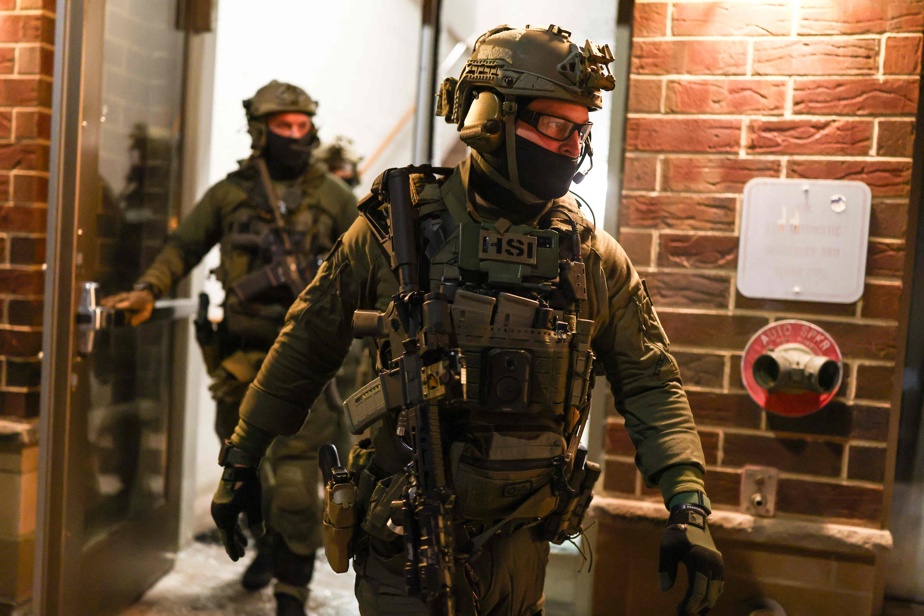
(Washington) White House border official Tom Homan said Sunday that more than 1,000 immigration agents have left Minnesota’s Twin Cities region and hundreds more will leave in the coming days as part of the Trump administration’s reduction in immigration enforcement personnel.
Published at
A “small” security force will remain on site for a short time to protect the remaining immigration officers and will intervene “when our officers are outside and they are surrounded by agitators and things get out of control,” Homan told CBS’s Face the Nation. He did not specify what he meant by “small”.
He also said agents would continue to investigate the fraud allegations as well as the anti-immigration protest that disrupted a church service.
“We have already expelled more than 1,000 people, and by Monday or Tuesday, we will expel several hundred more,” added Mr. Homan. We will return to our initial activity level. »
Thousands of agents were sent to the Minneapolis and Saint Paul area as part of Operation Metro Surge led by U.S. Immigration and Customs Enforcement.
The Department of Homeland Security said it was the largest immigration enforcement operation ever conducted and that it was successful. But that crackdown came under increasing criticism as the situation became more volatile and two U.S. citizens were killed.
Demonstrations have become commonplace. A network of residents mobilized to help immigrants, warn them of the arrival of agents or film the actions of immigration agents.
The shooting deaths of Renee Good and Alex Pretti, shot by federal agents, drew condemnation and raised questions about the agents’ behavior, leading to changes in the operation’s conduct.
Mr. Homan announced last week that 700 federal agents would immediately leave Minnesota, but there were still more than 2,000 left in the state. He said Thursday that a “significant reduction” was already underway and would continue throughout the week.
Mr. Homan said enforcement action would not stop in the Twin Cities and mass evictions would continue across the country. Officers who leave Minnesota will return to their posts or be assigned elsewhere.
Asked if future deployments could reach the scale of the Twin Cities operation, Homan said: “It will depend on the situation.” »



