

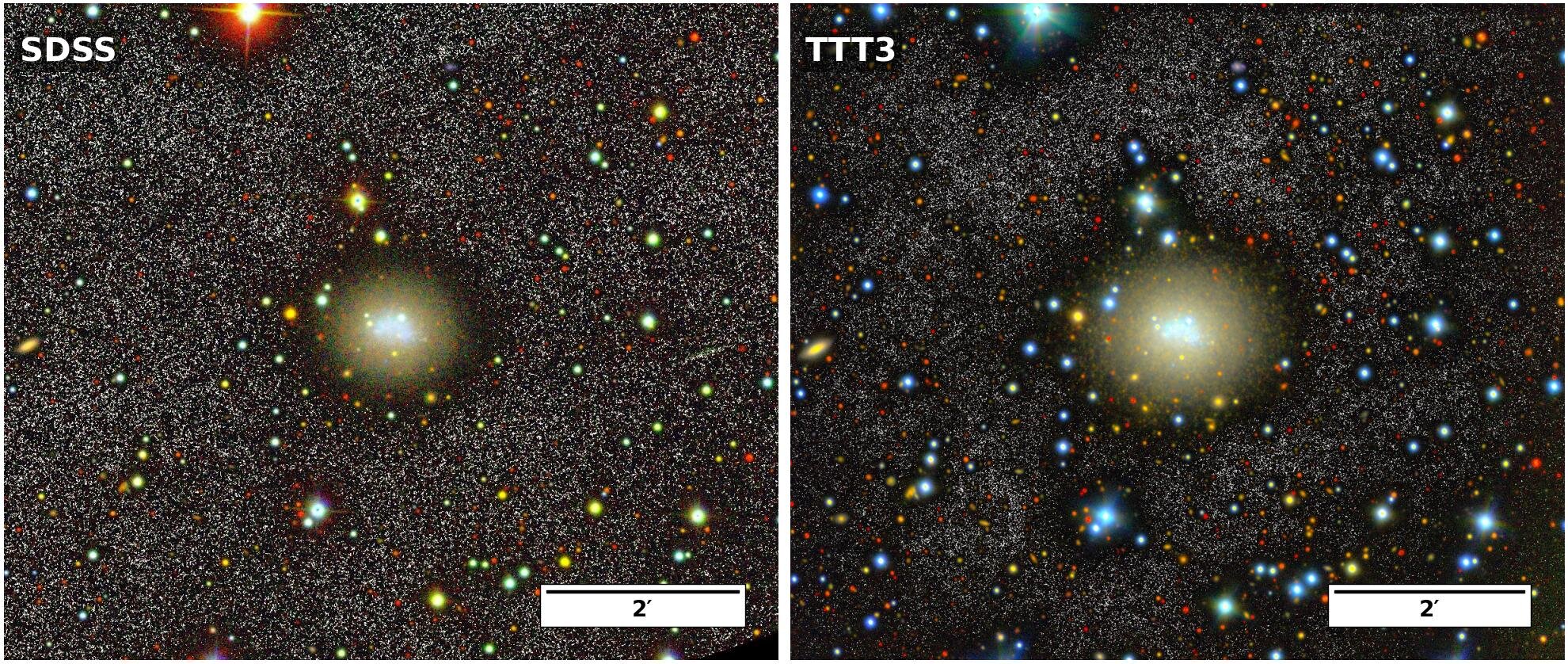
NGC6789 as seen by the Sloan Digital Sky Survey (left panel) and the deep image obtained using the TTT3 telescope (right panel). In both cases, the color images were created using a combination of Sloan g, r and i filters. At a distance from the galaxy of 3.6 Mpc, one arcmin corresponds to approximately 1.1 kpc. The black and white background of the image corresponds to the G-band image, which is our deepest dataset. Credit: arXiv (2025). DOI: 10.48550/arxiv.2511.07041
Using the Twin Two Meter Telescope (TTT3), Spanish astronomers have carried out deep optical imaging of an isolated dwarf galaxy known as NGC 6789. The results of the new observations, presented November 10 on the arXiv preprint server, has provided a better understanding of the star formation process in this galaxy.
Isolated but forming stars
Discovered in 1883, NGC 6789 is a blue compact dwarf galaxy (BCD) located about 12 million light years away in the local vacuum, a region of space with far fewer galaxies than its surroundings. However, despite its extreme isolation, NGC 6789 shows recent central star forming activity.
Previous observations of NGC 6789 revealed that about 4% of its total stellar mass, or about 100 million solar masses, was formed over the past 600 million years. It turned out that the central star-forming region of this galaxy is embedded in a redder, apparently intact, outer elliptical structure.
One question remains unanswered
Therefore, what still baffles scientists is the source of the gas fueling the recent star formation in NGC 6789, given that the galaxy is isolated and has an undisturbed shape.
To answer this question, a team of astronomers led by Ignacio Trujillo of the University of La Laguna in Spain used TTT3 to make deeper optical observations of NGC 6789 than previously made.
“We present much deeper multiband imaging of NGC 6789 to explore its outer regions and search for faint features that could reveal evidence of past minor mergers or gas accretion events capable of providing the fuel needed to build its star-forming core,” the researchers explained.
Deep image of NGC 6789 obtained using the TTT3 telescope. Credit: Trujillo et al., 2025.
Nothing there?
The new observations revealed that NGC 6789 maintains its elliptical shape up to a luminosity of around 30 mag/arcsec.2 (in G band), or at a radial distance of 1.5 arc minutes, and that it exhibits a significant color gradient due to its central star-forming region. Therefore, no evidence of tidal features or melting remains was found.
Additionally, the data collected allowed astronomers to set an upper limit on the amount of stellar mass that could potentially surround NGC 6789 following the disruption of any small satellite. This value has been calculated to be around 200,000 solar masses.
The researchers pointed out that the number of new stars in the central region of NGC 6789 is around 4 million solar masses. Thus, they assume that the absence of visible stellar streams around the galaxy indicates that its central starburst is either of internal origin or produced by the recent infall of virgin gas.
“Its recent central star formation was likely produced either by in situ residual gas or by the accretion of external pristine gas not associated with minor fusion activity,” the paper’s authors explain.
Written for you by our author Tomasz Nowakowski, edited by Gaby Clark, and fact-checked and revised by Robert Egan, this article is the result of painstaking human work. We rely on readers like you to keep independent science journalism alive. If this reporting interests you, consider making a donation (especially monthly). You will get a without advertising account as a thank you.
More information:
Ignacio Trujillo et al, Deep imaging of the very isolated dwarf galaxy NGC6789, arXiv (2025). DOI: 10.48550/arxiv.2511.07041
Journal information:
arXiv
© 2025 Science X Network
Quote: Deep imaging suggests isolated galaxies forming stars with no signs of past mergers (November 18, 2025) retrieved November 18, 2025 from
This document is subject to copyright. Except for fair use for private study or research purposes, no part may be reproduced without written permission. The content is provided for informational purposes only.



