

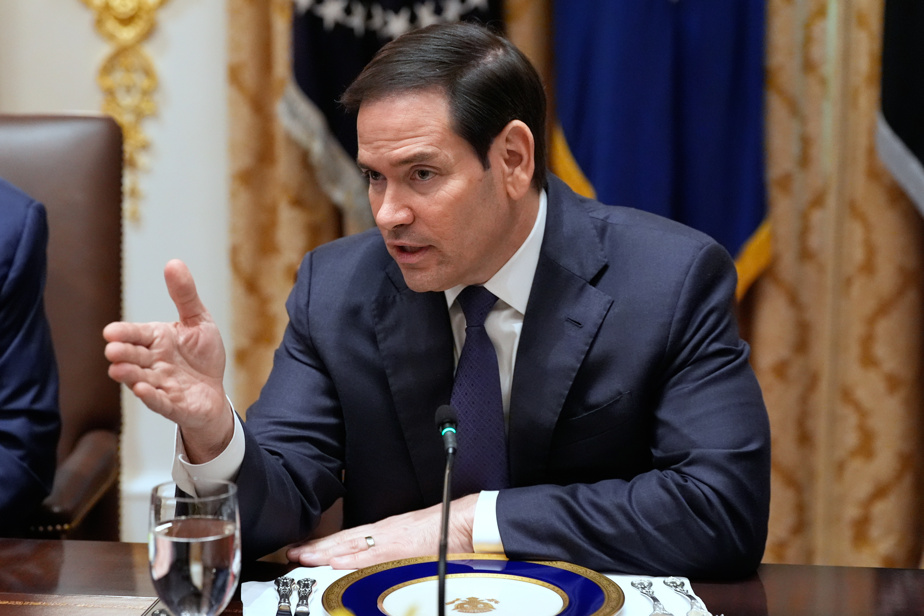
(New York) Within hours of each other, on February 24, 2019, Marco Rubio posted photos on Twitter showing Panamanian dictator Manuel Noriega in prison and Libyan leader Muammar Gaddafi, with his face bloodied, minutes before his death.
No explanation accompanied these images. But the one who was still a senator from Florida didn’t need to add any more. Everyone suspected that he wished such an ignominious end to the authoritarian president of Venezuela, Nicolás Maduro, then facing a serious political and economic crisis.
Two days later, Marco Rubio would confirm the parallel, if indeed he needed to do so.
“The Maduro regime has many of the characteristics of dictatorships that appear strong, then suddenly collapse,” he was to explain to the Miami Herald.
PHOTO FEDERICO PARRA, AGENCE FRANCE-PRESSE ARCHIVES
The President of Venezuela, Nicolás Maduro
“It’s a reminder that things don’t always go well for dictators.” Their own people eventually got rid of them. »
At the end of October 2025, Marco Rubio still has the same wish for Venezuela. It is an old obsession which is partly due to the desire of this son of anti-Castro Cuban exiles to weaken the communist island, a close ally of Caracas.
However, having become Secretary of State and White House National Security Advisor, Marco Rubio now holds power and influence which allow him to contribute directly to the realization of this wish, and perhaps even to take charge of it himself.
It is generally agreed that the man Donald Trump has already denigrated by calling him “Little Marco” is the main architect and promoter of the policy that could lead to a military conflict with Venezuela, whose role in the export of drugs to the United States represents in his eyes an “imminent danger”.
It’s hard not to see him as another Dick Cheney, the gray eminence who encourages the president to give the green light to regime change in a foreign country for dubious reasons.
The mother of all offers
But Nicolás Maduro is nothing like Saddam Hussein. During months-long negotiations, he presented the Trump administration with the mother of all offers to avoid a clash with the United States.
“As part of a deal discussed between a senior U.S. official and Mr. Maduro’s top aides, the Venezuelan strongman proposed opening all existing and future oil and gold projects to U.S. companies, granting preferential contracts to U.S. companies, reversing the flow of Venezuelan oil exports from China to the United States, and slashing contracts energy and mining interests of his country with Chinese, Iranian and Russian companies,” summarized the New York Times in an exclusive published on October 10.
That offer remained on the table as the United States stepped up strikes in the Caribbean Sea against boats suspected of carrying drugs and carried out the largest military deployment to South America since the Cold War.
The military escalation reached a peak last Friday with the announcement of the dispatch to the region of the aircraft carrier Gerald R. Fordthe largest in the world, as well as accompanying warships and combat aircraft.
US NAVY PHOTO, PROVIDED BY REUTERS
The aircraft carrier Gerald R. Ford
The same day, Defense Secretary Pete Hegseth announced the tenth strike against a boat accused of being linked to drug cartels. According to his account, six people were on board the boat, bringing to 43 the number of suspected drug traffickers summarily eliminated since the start of this campaign deemed illegal by many experts.
On October 17, Donald Trump confirmed the Venezuelan president’s offer in front of journalists at the White House.
“He offered everything. Do you know why? Because he doesn’t want to mess with the United States,” declared the president, who ended up rejecting the offer, as Marco Rubio recommended.
“Cartel boss” and “fugitive”
This refusal reinforced the idea that Washington wants regime change in Venezuela, where Donald Trump has authorized the CIA to carry out covert operations and where he has not ruled out the possibility of strikes.
According to this thesis, the “armed conflict” decreed by Donald Trump against “cartels” now classified as international terrorist organizations would only be a pretext leading to the fall of Nicolás Maduro.
Hugo Chávez’s successor is no longer only portrayed by the Trump administration as an “illegitimate” president whose re-election was contested in August 2024. According to the new rhetoric adopted by Marco Rubio, he is also – and above all – a cartel leader and a “fugitive” from American justice.
Recently, the Secretary of State has repeatedly recalled the indictment of the Venezuelan president and around thirty of his allies by a federal grand jury in New York for narcoterrorism and drug trafficking, in March 2020.
As part of this indictment, Nicolás Maduro is accused of having “flooded the United States with cocaine” at the head of a criminal organization called “Cartel de los Soles”, which was added last July by the Trump administration to the list of international terrorist organizations.
Marco Rubio also accused the Venezuelan president of leading the criminal organization Tren de Aragua, which US intelligence denied. Nevertheless: within the Trump administration, he counts among his most important allies Stephen Miller, deputy chief of staff of the White House, and John Ratcliffe, director of the CIA.
He is also in contact with several figures of the Venezuelan opposition, including María Corina Machado, winner of the 2025 Nobel Peace Prize, who is in favor of regime change in her country.
Change that can only come about by force, according to one of the advisors of the woman Marco Rubio nicknamed the “Venezuelan Iron Lady”.
Even if he doesn’t say it publicly, the US Secretary of State probably feels the same way.



