

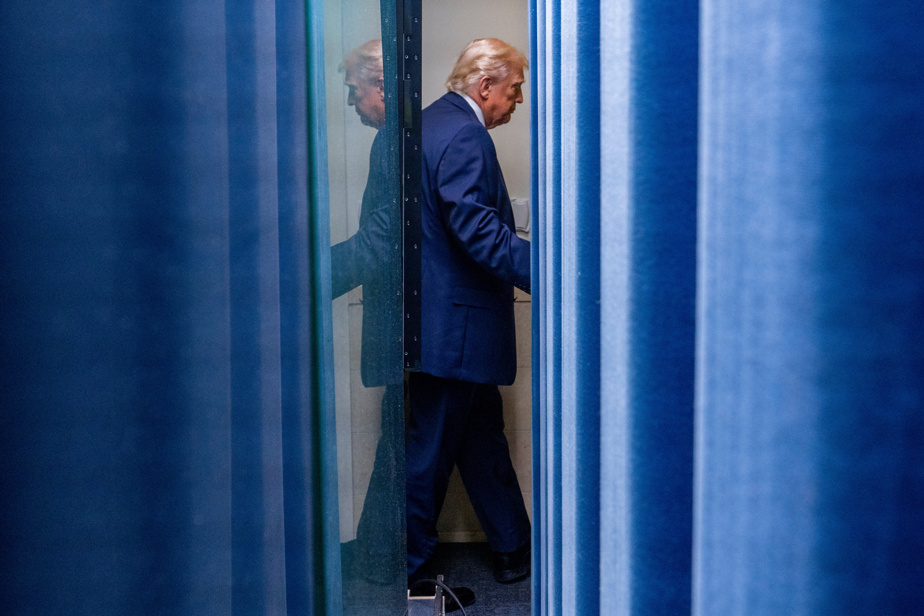
The Supreme Court dealt a rare setback to Donald Trump on Friday with its decision on customs duties. The president strongly criticized the judges, while ensuring that he could put in place new measures “which will bring even more money” to the United States. Return to the political question surrounding the cause.
Published at
How did Donald Trump react?
The US president said he was “deeply disappointed” by the Supreme Court’s decision, handed down with a majority of six out of nine judges – meaning that three conservative judges joined the three liberal judges. “I am ashamed of certain members of the Court, absolutely ashamed that they did not have the courage to do what is right for our country,” he said Friday afternoon at a press briefing, also suggesting foreign interference. Two of the judges who rejected the administration’s arguments, Amy Coney Barrett and Neil Gorsuch, were appointed during Trump’s first term.
He then congratulated the three other magistrates who agreed with him and praised the “genius” of Judge Brett Kavanaugh, also confirmed under his presidency, for the solutions put forward in his dissident opposition.
Trump also announced new customs duties of 10% for the majority of countries, and assured that he had other means of achieving his ends. The agreements already concluded would be maintained, he clarified. The judges did not rule on possible reimbursements or their terms.
Is the decision surprising?
Not exactly. The questions asked by the judges during the hearings a few months ago had given certain indications on their way of interpreting the question submitted, namely the use ofInternational Emergency Economic Powers Act (IEEPA) to justify the unilateral imposition of tariff measures. This law gives the president latitude in times of national emergency, without going through Congress, to target foreign interests, but has never before been used to impose tariffs. The judges therefore did not rule on the notion of urgency, but on the applicable framework.
Above all, the question of customs duties is far from unanimous, even among Trump’s supporters. “I think the politics around this issue gave conservatives on the Supreme Court a real opening and they took advantage of it,” comments Matthew Dallek, professor at George Washington University. Because customs duties are quite unpopular among the population. They have divided the conservative movement, even under Trump. »
The Heritage Foundation group, in its very conservative Project 2025 roadmap, had for example presented the two visions in its plan for a future Republican president: the imposition of customs duties on one side, the defense of free trade on the other. While the other subjects – the civil service, abortion, the environment, for example – were approached from a united position.
What political impact for the president?
It’s still early to say, and everything will depend on what happens next. Customs duties were a flagship measure of the Trump administration, but for a good number of voters, the economic issue is mainly linked to the cost of living – the means used were not central. However, the price of food and goods has continued to increase over the past year, according to the Consumer Price Index. Medical insurance costs have also jumped for many Americans.
The harsh criticism of judges on the nation’s highest court and the promise to stay the course against countries that “take advantage” of the United States are likely to please Trump’s base. “Part of his electorate will react to his attacks against the Democrats, the unelected judges, the elites who, he says, are destroying the country,” notes Mr. Dallek. But it’s a familiar card, something you’ve heard many times before. »
The remarks find a favorable response among convinced supporters. But these voters are not the ones who change the game on election day.
And what’s next?
The administration will have to look at other, less flexible, measures at its disposal. Legal recourse for possible reimbursements may take time. Trump is scheduled to address Americans Tuesday evening in the State of the Union address. It wouldn’t be surprising if he returned to the Lost Cause today.
Last year, four members of the Supreme Court attended the address: conservative Justices John Roberts, Brett Kavanaugh and Amy Coney Barrettt, and liberal Justice Elena Kagan. Asked whether the judges who ruled against his way of imposing customs duties were still invited, he replied “barely.” “Honestly, I don’t care if they come or not,” he said.



