

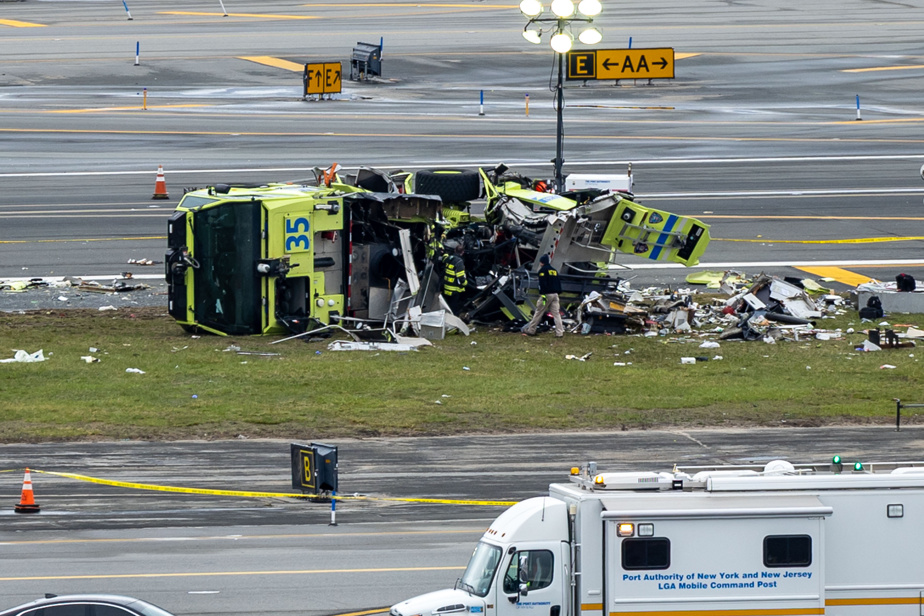
(New York) A succession of failures could explain the tragic accident which claimed the lives of the two pilots of Air Canada flight 8646 departing from Montreal on Sunday evening at LaGuardia airport.
Published at
“We rarely, if ever, investigate a major accident due to a single fault. Our aviation system is incredibly safe because it has multiple, multiple layers of defense to prevent an accident,” said Jennifer Homendy, chairwoman of the National Transportation Safety Board (NTSB), during a highly technical press conference at LaGuardia Airport Tuesday afternoon.
In the crosshairs of investigators from this independent agency: the role played by the two air traffic controllers on duty during the night shift. “It is not clear who performed the ground control functions. We have conflicting information,” said M.me Homendy.
PHOTO JOSIE DESMARAIS, THE PRESS
Air Canada Flight 8646 after collision
At the time of the press briefing, the latter had still not been encountered, just like the two firefighters who were in fire truck 1 which crossed the landing strip shortly before the impact.
At this time, the NTSB does not know whether Sergeant Michael Orsillo and Officer Adrian Baez – who were in the cab of the truck and survived the impact – heard the command “stop, stop, stop” issued from the control tower.
“We know that this controller remained on duty for several minutes after the incident, when he normally should have been relieved. This raises questions,” underlined Mr.me Homendy. The presence of only two air traffic controllers during what is nicknamed the “midnight shift” is a usual practice, underlined Jennifer Homendy.
PHOTO JOSIE DESMARAIS, THE PRESS
Jennifer Homendy, Chairman of the National Transportation Safety Board (NTSB)
“On the other hand, I would like to remind you regarding the midnight shift, we at the NTSB have raised many concerns regarding fatigue. We don’t know if that’s a factor here, but it’s a shift we’ve focused on in past investigations. »
Another line of inquiry: the fact that the monitoring system supposed to inform controllers of surface movements on the runway – the ASDE-X system – did not work.
“ASDE-X did not trigger an alert due to the immediate proximity of vehicles entering and leaving near the landing strip, which prevented the creation of a reliable trajectory,” Jennifer Homendy insisted three times, insisting that she should be cited as such.
But in any case, Jennifer Homendy said that unlike other vehicles, the fire truck was not equipped with a transponder that could have communicated the truck’s location to the ASDE-X system. In some airports, fire trucks have them.
Several questions therefore remain unanswered and Mme Homendy called on the public to be patient. “We are here to prevent this from happening again. And it’s going to take time.”



