

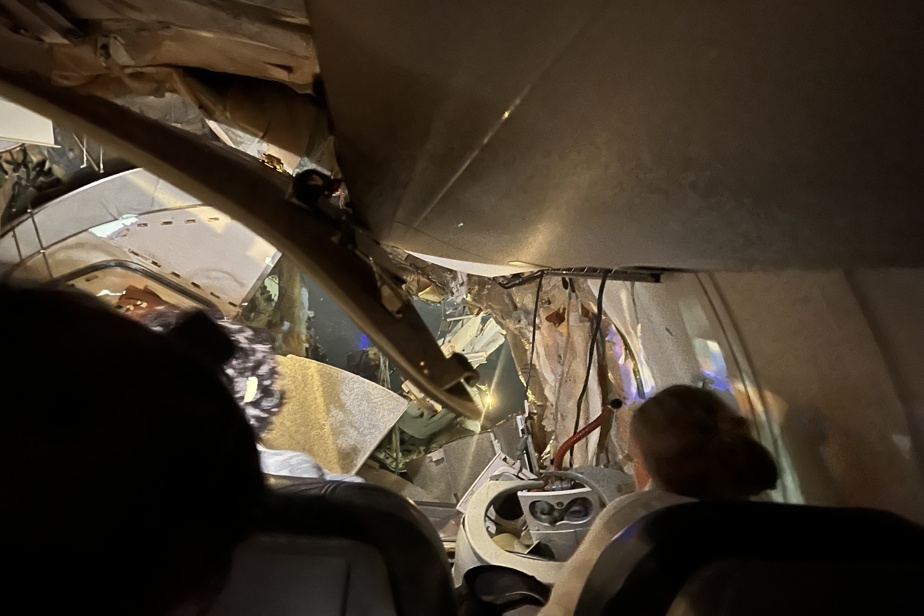
(New York and Montreal) A few seconds after Air Canada Flight 8646 landed on the tarmac at LaGuardia Airport, Clément Lelievre saw the plane’s cockpit “disappear”.
Published at
“I was like that, calm in my seat looking ahead, and suddenly there was intense braking,” says the passenger in seat 21F. “I don’t even know how to explain it, everything was destroyed in front. »
Sitting in a bar on the Upper East Side in Manhattan, the 36-year-old man was still “on the adrenaline rush”. He smiled, he cried, but above all, he felt like he had received a “second chance”. “We’re alive,” he said of his group of passengers. “We are all connected to life. »
PHOTO JOSIE DESMARAIS, THE PRESS
Clement Lelievre
The Frenchman established in the Big Apple is very grateful to the pilot, Antoine Forest, who tragically lost his life in the accident, but who was able to brake in time to minimize the force of the impact, he believes. “He saved us. »
“Having the reflex to brake like that when everything is going fast, he was a real aviator. »
A flight attendant, Solange Tremblay, was seriously injured after being ejected from the plane while still strapped to her seat.
“Frankly, it’s crazy because I saw her disappear,” says Clément Lelievre, who lived in Montreal for four years.
The latter was in the operating room for many hours at a hospital in the borough of Queens, until early evening.
“I’m very happy for Solange, who I don’t know personally, but I found her so likeable. »
PHOTO JOSIE DESMARAIS, THE PRESS
Elmhurst Hospital, Queens, New York
Once the plane came to a stop, the passengers all remained calm and helped each other escape through the wings of the plane. “I will remember that everyone was exemplary. »
The impact
It was barefoot in his slippers, with the clothes he was wearing during the accident, that Montrealer Antoine Poncy arranged to meet us Monday evening in front of his hotel. Wounded on his feet, in short sleeves despite the cold, he still seemed shaken.
“I was in seat 3F. “You shouldn’t have been much further ahead than that,” he says.
Antoine Poncy was dozing when the plane landed on Runway 4 at LaGuardia Airport in New York on Sunday evening. He opened his eyes and quickly realized something was wrong. “The plane rolled for three, four seconds, then I felt it brake very, very hard, not as usual. And there was the impact. »
PHOTO JOSIE DESMARAIS, THE PRESS
Antoine Poncy
It was super violent. It looked like we had hit a wall.
Antoine Poncy, passenger of flight 8646
The plane continued its course for several meters after hitting the fire truck. Then, the device stopped.
A heavy silence settled. He doesn’t remember people screaming or calling for help. His neighbor said they were going to have to go out.
Mechanically, he put on his shoes, retrieved his glasses which had fallen off in the violence of the shock, then went in search of his cell phone. This father feared not finding him and leaving his loved ones in anguish, without news of him.
Little by little he began to understand the catastrophe that had just occurred. Before his eyes, he saw that the cockpit had been “pulverized” and the front of the plane was “completely compacted.”
In the first row, “a woman said that her leg was blocked or broken, that she could no longer move. Another woman was unconscious, her head tilted, her hair full of blood,” he says.
He tried to help her. He noticed, relieved, that she was breathing.
Help began to arrive. He called out to a firefighter through the gaping “hole” that had replaced the cockpit, to tell him that people were seriously injured up front. The firefighter told him to get out, that they would take care of it.
As he headed towards the emergency exit, at wing level, the ground gave way under his feet. Until now, the plane had remained horizontal, in a precarious balance; but the aircraft then tilted backwards, the nose – or what was left of it – pointing towards the sky. Antoine Poncy was probably one of the last passengers still inside.
PHOTO PROVIDED BY CLÉMENT LELIEVRE
The aircraft suddenly rolled backwards moments after coming to a stop.
When the ground stabilized, he was finally able to get out.
The surviving passengers then waited for long minutes in the cold, in the rain, on the airport tarmac. Along with other passengers, Antoine Poncy was eventually taken to a nearby hospital to undergo examinations and make sure nothing was broken. It was only in the early morning that he was finally discharged.
PHOTO PROVIDED BY CLÉMENT LELIEVRE
Survivors transported off the tarmac by emergency services
Apart from severe pain in his ribs, a cut on his foot and bruising caused by the seat belt – which was “really useful”, he emphasizes – he did not suffer any serious injuries.
The reason he was sitting in the third row was because he had been upgraded a week before. “I remember that I hesitated, I almost took a place in the first row,” he recalls. It really doesn’t matter much. »
His wife decided to join him on Tuesday so that he does not return to Montreal alone, whether by car or plane.
“I don’t think it’s going to stop me from flying,” says the man who also has his private pilot’s license. “But I’m not sure I yet fully realize the psychological impact it had on me. »



