

President Donald Trump said Friday he was ready to finance the main American food aid program, which must be frozen from Saturday due to the budgetary paralysis in the United States, after a court decision ordering its maintenance.
“I don’t want Americans to go hungry (…). If the court gives us the appropriate legal directives, it will be MY HONOR to provide funding” for the SNAP program, the American president wrote on his Truth Social network.
SCREENSHOT OF DONALD TRUMP’S TRUTH SOCIAL ACCOUNT
Each month, nearly 42 million Americans receive a benefit to help them pay for groceries. The government’s budgetary paralysis threatens the next monthly payment, scheduled for Saturday.
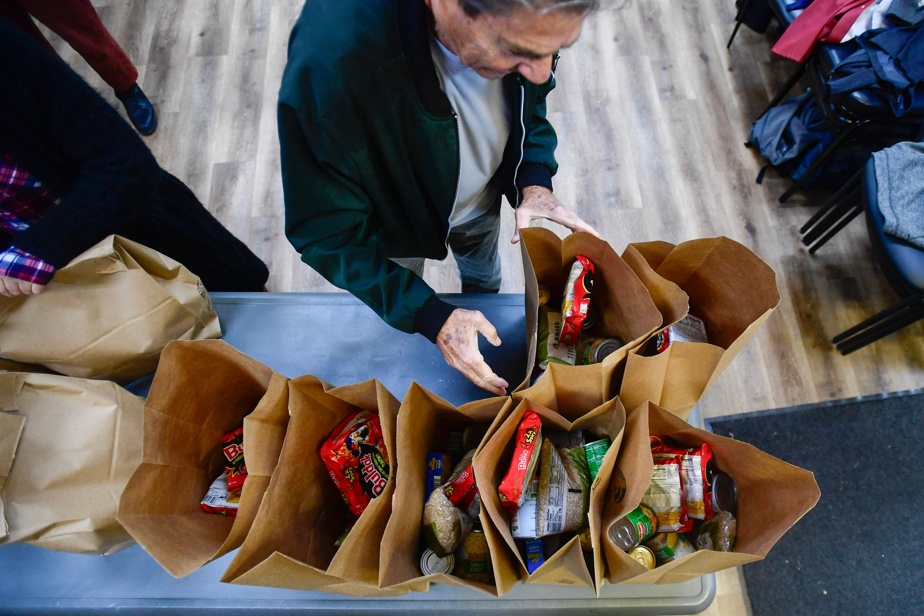
“We’re in the middle of an almost perfect storm,” says Lizza Garza Harrison, communications director for the East Mountain Food Pantry near Albuquerque, New Mexico. This organization, made up entirely of volunteers, distributes baskets to people in financial difficulty.
New Mexico is the state with the highest proportion of Supplemental Nutrition Assistance Program (SNAP) recipients: 21.2% of residents rely on the supplement.
“We were already seeing an increase in demand and a decrease in donations,” explains M.me Garza Harrison. The baskets, made up of staples like beans, rice and canned meat, are “less stocked than before,” she adds.
Poverty line
The majority of those who visit this food aid counter are already SNAP recipients. But the allowances do not allow them to meet all their needs.
To be eligible for financial assistance, net monthly income must generally correspond, at most, to the poverty line. For a household of four people, it is US$2,600 (CAN$3,600) per month – US$31,299 (CAN$43,770) per year – which makes them eligible for a maximum benefit of US$975 (CAN$1,360) per month from SNAP.
Several factors come into play, such as state of residence, age, and whether a person is considered disabled. Beneficiaries receive US$187.20 ($261.80 CAD) monthly, on average, paid onto an electronic card that can be used to pay for grocery items at participating stores.
“The Program was designed to support reasonable eating, but with the lowest standards,” notes Colleen Heflin, a professor at Syracuse University who specializes in the field of food safety. An interruption of service would be a first in SNAP’s 60-year history. “It’s very alarming,” she emphasizes.
New provisions adopted last summer with the “Big Beautiful Bill” must also come into force on 1er November, notably tightening the eligibility criteria.
Political battle
The Department of Agriculture, responsible for SNAP at the federal level, published a message on its site warning that “the well is empty” due to budgetary paralysis, and that allocations cannot be paid to the states, which manage the program locally, on 1er november.
Elected officials and organizations are trying to find a solution; 23 attorneys general and 3 Democratic state governors sued the Department of Agriculture over its refusal to use emergency funds. A Rhode Island judge on Friday ordered the federal government to use the funds, rejecting the argument that the money could not be used for that purpose.
In Congress, elected Democrats and Republicans alike have presented bills which, without resolving the budgetary paralysis, would avoid a suspension of SNAP. Both parties accuse each other of being responsible for the crisis.
States, mainly Democratic, have announced emergency aid to food banks.
Special distributions
The organizations also see the deadline coming.
“We’re preparing to organize large drive-thru type distributions, a bit like we did during COVID, where we set up in a large parking lot and people can come and fill the trunk of their car with food,” says David May, senior director of marketing for the Los Angeles Regional Food Bank.
The organization manages a warehouse of donations and then sends them to some 600 partners in the region, responsible for distributing the food. “We are fortunate to be in a very generous community,” notes Mr. May, adding that needs have increased.
The threat comes after more than a month of budgetary paralysis, which deprives more than a million federal employees of pay. Civil servants also had to turn to food banks, according to several American media.
“States and philanthropy cannot succeed in completely compensating for the suspension of payment,” however, underlines Professor Colleen Heflin.
“A devastating moment”
The pause is also likely to result in broader impacts, since SNAP also supports the local economy.
“This is a devastating time for everyone in the food industry,” said Denise Miller, executive director of the New Mexico Farmers’ Marketing Association.
A program in New Mexico, for example, allows SNAP recipients to double the value of their benefit if they spend on in-state fruits and vegetables.
“We have participating farm families who also depend on SNAP for a benefit; they are already on low income,” notes Mme Miller.
Workers unable to make ends meet make up a significant portion of the East Mountain Food Pantry’s beneficiaries, Lizza Garza Harrison said. “They are veterans, single parents, people who live at the end of the street,” she illustrates. She also notes a mobilization of the community to help them, the organization having received more volunteer offers and donation collections recently.
“We receive a lot of calls from people who want to help,” she said. It makes us very humble. »
With Agence France-Presse



