


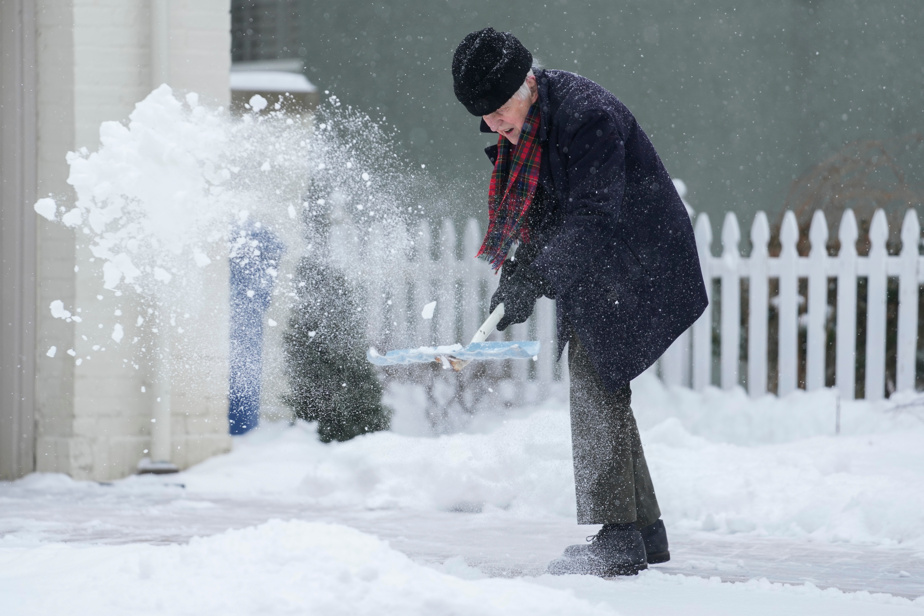
(Washington) A new winter storm hits the United States on Saturday, with rare snowfall in seaside resorts in the southeast and a cold wave from the Arctic that will hit as far as Florida.
Published at
This weather event comes a week after a snowstorm which hit last weekend from Texas to the capital Washington, disrupting transport and causing around a hundred deaths across the country.
This time, the phenomenon is twofold, predict the American weather services (NWS).
On the one hand, snowfall will fall from Saturday to Sunday on the Atlantic coast, and particularly around North and South Carolina. On the other hand, a polar cold wave is hitting two-thirds of the east of the country, from North Dakota to Florida, until Monday.
PHOTO JEFFREY COLLINS, ASSOCIATED PRESS
Snowflakes begin to fall in Columbia, South Carolina.
As an “Arctic air mass continues to surge south,” the NWS writes, a “coastal cyclone” is forming Saturday on the Atlantic coast and could bring snowfall as far as Georgia and blizzards to the Outer Banks.
Delayed rocket launch
Snow began falling Saturday morning on this stretch of coastal North Carolina known for its sandy beaches, and the storm could also bring marine flooding and strong winds.
Dare County, which includes this resort area, has been in a state of emergency since Friday. Authorities across the region are asking residents to limit travel as much as possible.
At the same time, the cold snap will cause negative temperatures as far as southern Florida, which has not been observed since 1989, notes the NWS.
These conditions have led NASA to postpone holding at Cape Canaveral a final major test of its rocket which will soon launch the Artemis 2 lunar mission.
In the north of the country, it was already freezing on Saturday morning, with -16°C recorded in Minneapolis, the scene in recent weeks of demonstrations against the Trump administration’s immigration policy.
This cold snap comes as tens of thousands of customers are still without power in the southern states of Mississippi and Tennessee, the aftermath of last weekend’s winter storm.
Heated shelters were opened and the national guard was mobilized in Mississippi, according to its governor Tate Reeves. “Thank you for taking care of your friends and neighbors this weekend,” he wrote on X on Saturday morning.
A growing body of research suggests that climate change may play a role in disruptions to the polar vortex, a vast system of cold air and low pressure that normally circulates over the North Pole.

