

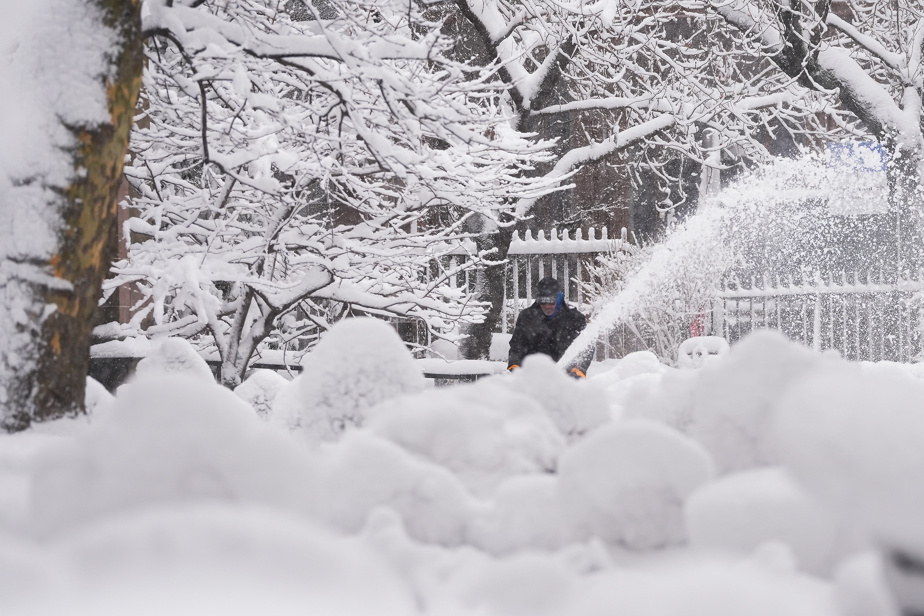
(New York) More than 40 million people face a snowstorm of rare magnitude in the northeastern United States on Monday. Up to 90 cm of snow expected in places, with gusts of 90 km/h and very low visibility.
Published at
Updated to
“According to current forecasts, the worst is over,” announced New York Mayor Zohran Mamdani during a press conference early in the afternoon.
Between 40 and 50 cm of powder snow had then fallen over most of the city and an additional 4 to 7 cm was expected by 8 p.m. local time, according to him.
PHOTO TIMOTHY A. CLARY, AGENCE FRANCE-PRESSE
A man walks in Central Park in Manhattan during a snowfall in New York on February 23, 2026.
The airport in Providence, Rhode Island, totaled a record 83 cm of powder and it was not excluded that the accumulations there would reach 90 cm by the evening.
The National Weather Service also warned of a risk of flooding in parts of New York, New Jersey and Massachusetts.
The governors of eight states (Connecticut, Delaware, Maryland, Massachusetts, New Jersey, New York, Pennsylvania and Rhode Island) therefore declared a state of emergency.
As a result of this storm, some 570,000 homes were without electricity shortly before 3 p.m., including more than 285,000 in Massachusetts.
PHOTO ROBERT MACMILLAN, REUTERS
A utility pole hangs after lines were downed by a fallen tree during a winter storm in Edgartown, Massachusetts, February 23, 2026.
“I don’t want to see any more snow”
Throughout the region, schools, municipal services, businesses, even the United Nations headquarters in Manhattan, remained closed for the day, to the delight of many schoolchildren sledding down the hills of Central Park.
After another storm on January 26, Dylan, 11, had “never seen so much snow in (his) life” and he “loves it.” “It’s really fun to play in the snow,” he told AFP.
PHOTO SETH WENIG, ASSOCIATED PRESS
Children play in Manhattan during a snowstorm in New York on February 23, 2026.
“It’s beautiful,” said Chris Crowell, 45, after a morning walk around the city, before working from home.
In Wildwood, in neighboring New Jersey, Vincent Greer, on the contrary, is “fed up”. “I don’t want to see any more snow,” he exclaimed as he shoveled a path in front of his building. “I can’t see anything in front of me and I’m freezing!” »
In places, public transport, including rail traffic, was disrupted on Monday, or even completely cut off in New Jersey.
In New York, the circulation of non-essential vehicles (personal cars, trucks, two-wheelers and electric bicycles), prohibited on Sunday evening, was authorized again since noon, but travel remained considered dangerous.
More than 6,000 flights had also been canceled by mid-afternoon, according to the specialist site FlightAware, with New York, Boston and Philadelphia airports being the most affected. And the disruptions were expected to continue on Tuesday with already nearly 2,000 cancellations.
PHOTO BRIAN SNYDER, REUTERS
Canceled flights are displayed on a board at Logan International Airport in Boston, Massachusetts, on February 23, 2026, during a winter snowstorm.
At the end of January, a previous storm followed by a long cold snap left around a hundred dead in the country, including at least 18 in New York alone, most of them from hypothermia.
“We are not aware of any deaths linked to this snowstorm on the streets of our city or in public places,” assured Monday the new Democratic mayor of New York, who took office at the beginning of January.
Like Philadelphia and Boston, the megacity strengthened its emergency reception system for vulnerable people on Sunday, including buses and schools accessible to those needing to warm up.



