


Published at
What exactly was decided?
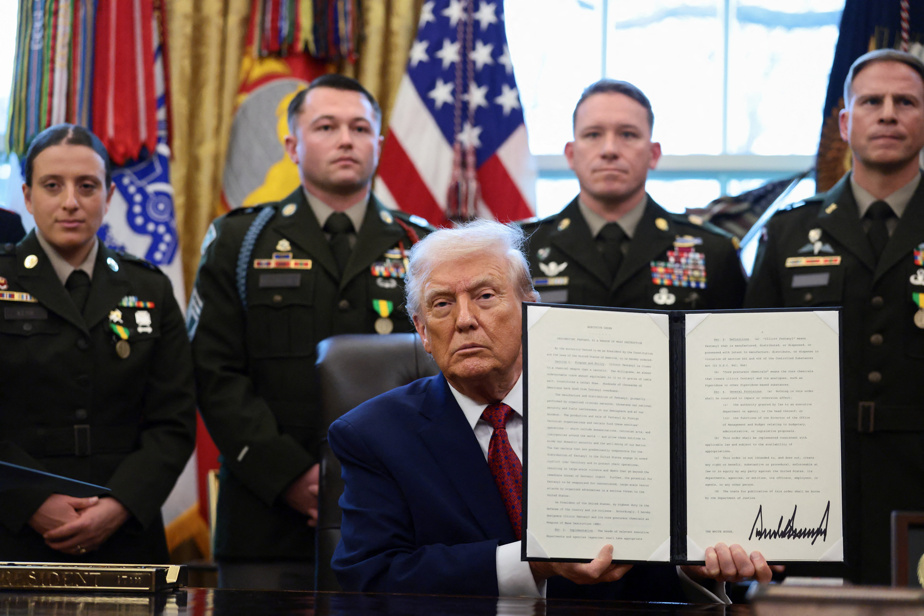
American President Donald Trump, who for several weeks has been increasing initiatives officially aimed at putting pressure on the drug cartels supplying the country with fentanyl, announced that the product would be formally designated as a WMD. He declared, in issuing an executive order on this subject on Monday, that “adversaries of the United States” are seeking to bring this product into the United States “in part because they want to kill Americans.” The cartels would even be likely, he said, to want to orchestrate “major terrorist attacks” using it. The decree orders the main departments to intensify their efforts to find the networks responsible for the trafficking and neutralize them.
Does this classification make sense?
John Caulkins, a Carnegie Mellon University professor who studies public drug control policy, notes that identifying fentanyl as a weapon appears dubious. A weapon, he says, must be used to kill, while this drug is produced and distributed by cartels who want to sell it for profit. Deaths occur, but they are not the desired result a priori. The idea that fentanyl could be used in mass killings is not credible either, emphasizes the researcher. “Fentanyl does not cause mass mortality incidents where many people die at the same time. Drugs cause a lot of individual incidents where people die,” he explains.
PHOTO DARRYL DYCK, THE CANADIAN PRESS
Baggies containing fentanyl seized by police in Surrey, British Columbia, 2020
What does it actually change?
Vanda Felbab-Brown, a Brookings Institution analyst who studies the U.S. opioid crisis, thinks the designation risks pushing relevant departments to give even more attention to fentanyl. “The administration says it is the equivalent of sarin gas, anthrax or plutonium,” she notes. She believes the decision also aims to facilitate the use of military forces and could potentially serve as a pretext for their deployment in American cities. John Walsh, a drug control policy specialist at the Washington Office on Latin America (WOLA), doubts the designation will make much difference to the resources devoted to fighting cartels. The designation aims first and foremost, according to him, to “beat the drums of war” to justify the aggressive posture adopted by the administration in its approach towards countries accused of being cogs in the trafficking of fentanyl, including Venezuela. Mr. Walsh believes that the reference to weapons of mass destruction is daring in terms of communication strategy since it refers to the American invasion of Iraq in 2003, which was wrongly justified by the presence of weapons of this nature. “There was no WMD in Iraq at the time and there is no fentanyl today in Venezuela,” he notes.
So what is the administration’s ultimate goal in Venezuela?
The muscular campaign targeting this oil-rich country, in particular the imposition since Tuesday of a partial oil blockade, in fact aims to hasten the fall of President Nicolás Maduro, judge John Walsh. The American objective results in part from the “obsession” of Secretary of State Marco Rubio, who hopes to create by driving the Venezuelan leader from power a domino effect leading to other left-wing authoritarian regimes. The current campaign also aims to send a message to Latin American leaders that they must “ideologically align” with the United States and favor the country’s geopolitical and economic interests or risk a heavy-handed response, notes Mr. Walsh.
PHOTO FEDERICO PARRA, AGENCE FRANCE-PRESSE ARCHIVES
The President of Venezuela, Nicolás Maduro, on December 10, in Caracas
Are we witnessing the return of American “imperialism” in the region?
Alan McPherson, a professor of history at Temple University, indicates that the new national security strategy recently unveiled by the Trump administration testifies without any ambiguity of the desire of the United States to make Latin America its zone of influence. The Monroe Doctrine, which was developed in the 19the century to justify American interventions in the region, officially aimed to protect the countries against any foreign interference. Even this justification, the analyst notes, is set aside in the new US strategy to emphasize that the United States and its companies must have access to the region’s natural resources and the infrastructure required to control them. “This is imperialism, pure and simple,” notes Mr. McPherson. He expects frictions to arise with China, which has expanded its economic ties with several Latin American countries. Instability could also manifest itself elsewhere in the world, for example if Beijing decides to attack Taiwan to strengthen its regional control in reaction to American pressure, warns the professor.


