


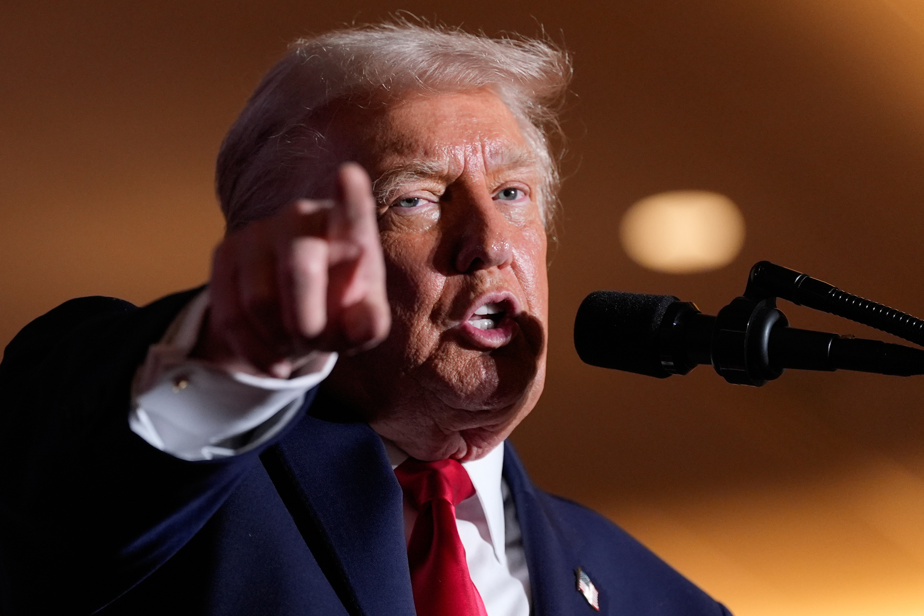
(Washington) In 2018, Donald Trump disputed having spoken of “shithole countries” whose nationals emigrate to the United States. From now on, he assumes and pushes his anti-immigration rhetoric with xenophobic overtones even further.
Published at
Tuesday evening, during a rally in Pennsylvania supposed to praise his economic policy, the American president very openly used this expression which caused a scandal when the press reported it during his first term.
“We had a meeting (with elected officials, editor’s note) and I asked ‘Why do we only take people who come from shitty countries?’ “Why can’t we have people from Sweden, from Norway?” “, reported Donald Trump.
“But we only take people from Somalia,” continued the Republican leader. “Calamitous places. Filthy, dirty, disgusting, riddled with crime.”
Recently, he described Somali migrants as “trash”.
These remarks “are further proof of his racist program,” Ed Markey, a senator from the Democratic opposition, commented on X.
Republican elected official Randy Fine, on the contrary, defended Donald Trump. “All cultures are not equal,” he said on CNN, adding “the president speaks a language that Americans understand.”
“This kind of reference to migrants (…) incapable of being part of an advanced society” has always existed on the margins of the American right, explains to AFP Carl Bon Tempo, professor of history at the University of Albany, in the state of New York.
“The difference is that, today, it comes directly from the White House and there is no more powerful megaphone,” continues the researcher.
During his campaign, Donald Trump increased attacks against illegal immigrants, particularly from Haiti and Latin America, accused of “poisoning the blood” of the country, a vocabulary compared by his opponents to that of the Nazis.
“No more filters”
Returning to power, he launched a vast and brutal campaign of expulsions. His government also suspended immigration applications for nationals of 19 of the poorest countries on the planet.
At the same time, the American president ordered to welcome white South African farmers, according to him persecuted.
“He no longer has any filter,” notes for AFP Terri Givens, professor at the University of British Columbia, specialist in immigration policies.
“It doesn’t matter whether an immigrant respects the law, owns a business, or has lived here for decades, he or she is caught in Trump’s battle against an imaginary enemy,” judges Mark Brockway, professor of political science at Syracuse University, interviewed by AFP.
PHOTO ANDREW CABALLERO-REYNOLDS, AGENCE FRANCE-PRESSE ARCHIVES
Homeland Security Secretary Kristi Noem
By describing immigrants as “leeches,” to use the term used by Secretary of Homeland Security Kristi Noem, the White House is pointing to a target at a time when Americans are worried about the cost of living.
But according to Carl Bon Tempo, “when immigration emerges as an issue, it is sometimes because of the economy, but also because of more fundamental questions around what it means to be American. »
“Reverse immigration”
On November 28, after a deadly attack carried out by an Afghan national against two National Guard soldiers in Washington, Donald Trump advocated “reverse immigration” or “remigration” on his Truth Social network.
This notion, developed by far-right European theorists such as the Frenchman Renaud Camus, designates the mass expulsion of foreigners.
It supports the conspiracy thesis of the “great replacement”, according to which a globalized elite would work in a hidden way so that non-Caucasian immigrant populations impose themselves demographically and culturally in Europe.
Many experts have also noted in the ideas of Donald Trump and his entourage echoes of the “nativist” movement of the 1920s in the United States, according to which the American identity would be above all white, Anglo-Saxon and Protestant.
This led at the time to an immigration policy favoring populations from Northern and Western Europe.
Influential White House advisor Stephen Miller recently wrote about X: “This is the big lie of mass immigration (…). On a large scale, migrants and their descendants recreate the conditions and horrors of their dysfunctional countries of origin. »


